Horsehead & Flame Nebula — Where Fire Meets Shadow
Click here to learn more.

Description
Description
The Wonder
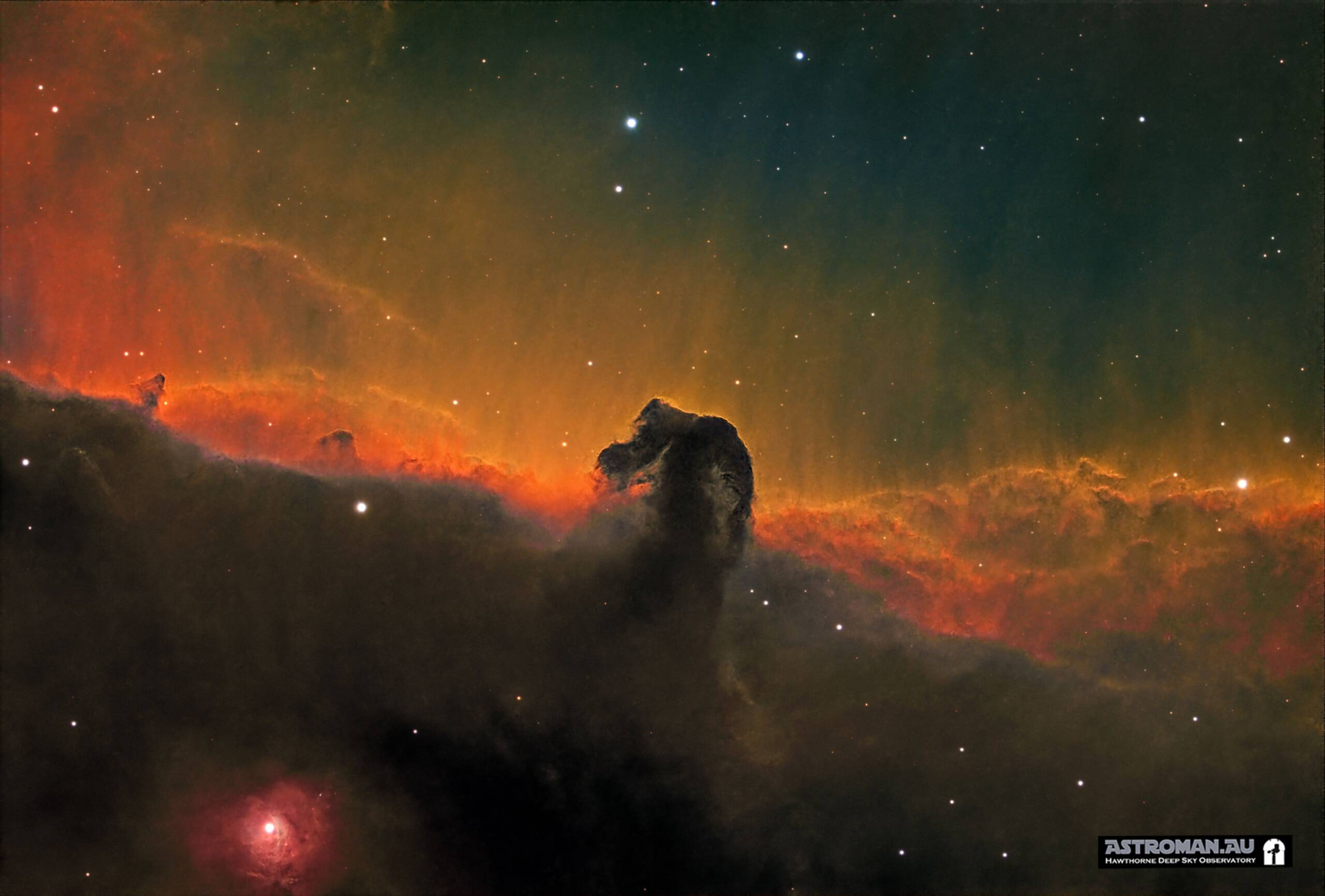
Few regions of the night sky create such a powerful contrast between light and darkness as the Horsehead and Flame Nebulae.
Located approximately 1,300 light-years away in the constellation Orion, this extraordinary region brings together two very different forms of cosmic sculpture. One appears as a dark horse’s head silhouetted against glowing hydrogen; the other burns like an immense celestial flame beside the bright star Alnitak, one of the three stars forming Orion’s famous Belt.
Captured with a wide-field ASKAR FRA400 quintuplet astrograph, this artwork embraces the scale of the surrounding region rather than concentrating on a single structure. The wider field reveals the relationship between the Horsehead, the Flame and the vast clouds of gas and dust surrounding them.
It is a scene defined by an extraordinary visual paradox:
Fire and shadow. Light and darkness. Creation and destruction.
The Horsehead — A Shadow in the Stars
The famous Horsehead Nebula (Barnard 33) is not glowing by itself.
Its unmistakable silhouette is created by a dense cloud of cold interstellar dust and gas lying in front of a much larger region of luminous hydrogen. The dust absorbs the light behind it, creating the dark profile that has made the Horsehead one of the most recognisable shapes in astrophotography.
The apparent horse is therefore a cosmic silhouette—a structure sculpted by the interaction of light and matter.
Yet this seemingly dark region is far from empty.
Within and around these dense clouds are the raw materials from which future generations of stars can form.
The Flame — A Nebula Ablaze
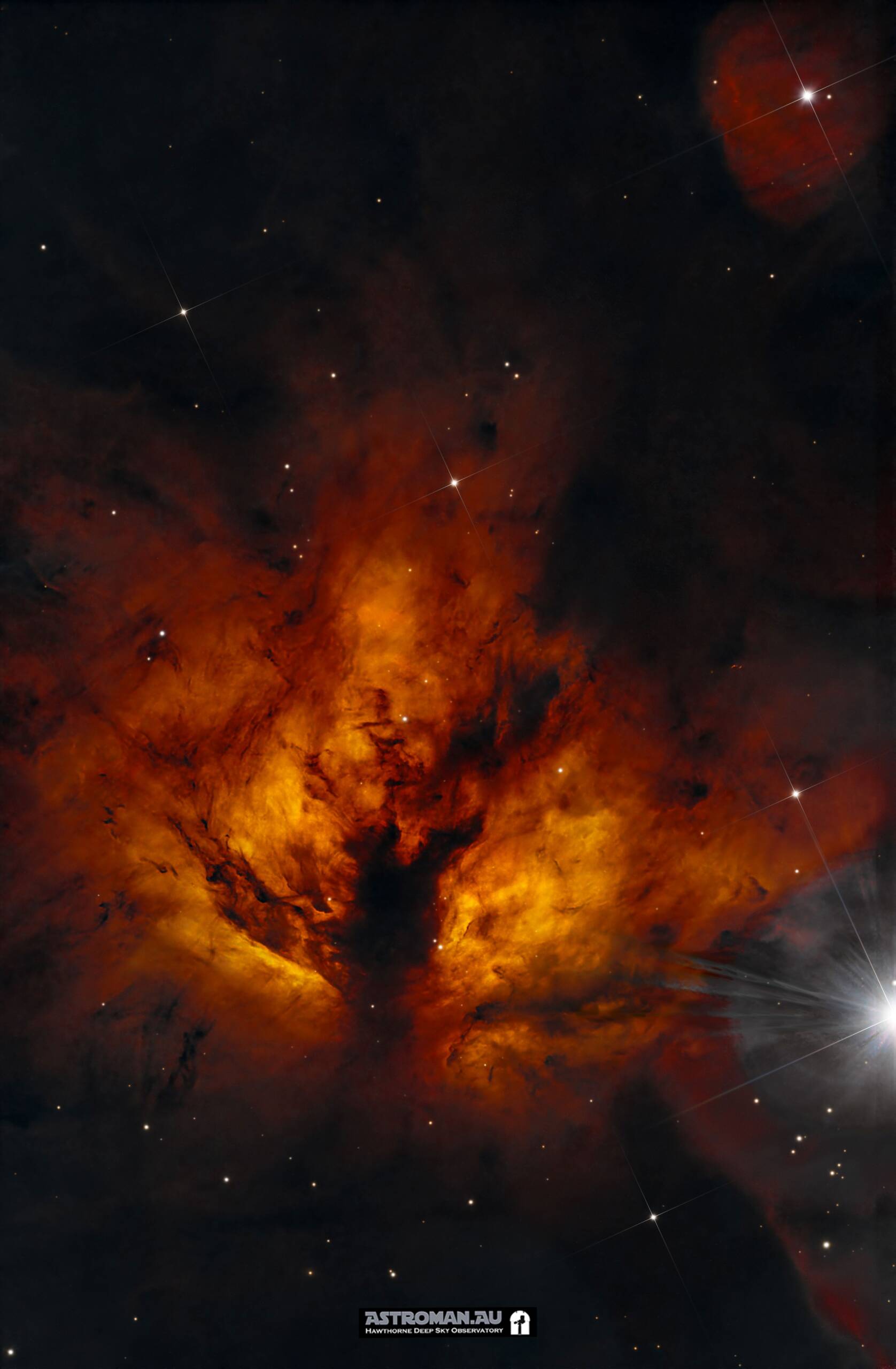
Just beside the Horsehead lies the Flame Nebula (NGC 2024), illuminated by the intense radiation of Alnitak.
Here, the appearance is dramatically different.
The surrounding gas glows as it is energised by ultraviolet radiation from nearby massive stars, while intricate lanes of dark dust cut through the luminous structure.
The result resembles a vast flame rising through space—but, like the Horsehead, the appearance is created by real physical processes rather than fire in the conventional sense.
Together, the two nebulae create one of nature’s most remarkable compositions:
a dark cosmic horse standing beside a flame of glowing gas.
A Stellar Nursery
This region of Orion is part of a much larger complex of molecular clouds where stars are being born.
Deep within these clouds, gravity gathers gas and dust into increasingly dense regions. As these concentrations collapse, new stars begin to form.
Radiation and stellar winds from young stars then interact with their surroundings, illuminating, compressing and eroding the clouds around them.
The result is a constantly evolving landscape in which the ingredients for future stars are being assembled while existing stars reshape their birthplace.
What looks like a tranquil scene from Earth is, on astronomical timescales, an extraordinarily active environment.
A Journey Through Time
The light from this region has travelled roughly 1,300 years to reach us.
Every star and filament in this photograph is therefore a glimpse into the past. The photons captured by the telescope began their journey when events were unfolding on Earth that belong to a very different chapter of human history.
Astrophotography turns this immense distance into something tangible.
We are not simply looking at objects in space.
We are looking backwards through time.
From Photons to Photograph
Capturing the relationship between the Horsehead and Flame required a telescope capable of combining a broad field of view with excellent optical performance.
The image was captured using an ASKAR FRA400 quintuplet-design astrograph, a wide-field instrument ideally suited to revealing the surrounding environment rather than isolating a single nebula.
Multiple long-exposure frames were collected to accumulate the faint light from the hydrogen-rich clouds and subtle dust structures. Narrowband imaging techniques can further isolate the characteristic emissions of elements such as hydrogen, sulfur and oxygen, allowing the complex architecture of the nebulae to emerge from the darkness.
The individual frames were then calibrated, integrated and carefully processed to reveal the delicate balance between the luminous emission regions and the dense dust clouds that create the dramatic silhouettes.
The objective was not simply to produce a colourful image, but to preserve the depth, texture and sense of scale of this extraordinary region of Orion.
The Astrophotographer’s Perspective
Wide-field astrophotography offers a different way of seeing.
A close-up can reveal extraordinary detail within a nebula, but stepping back can reveal relationships that are invisible when viewing individual objects in isolation.
With the Horsehead and Flame, that wider perspective is particularly compelling.
The Horsehead is defined by darkness. The Flame is defined by light. Yet both are shaped by the same fundamental forces—radiation, gravity, gas and dust.
That contrast is what drew me to this composition.
Sometimes the most dramatic stories in the universe are told not by light alone, but by the way light meets darkness.
The Artwork
Horsehead & Flame Nebula — Where Fire Meets Shadow is a striking wide-field portrait of one of the most recognisable landscapes in the night sky.
Its strong visual contrast, intricate textures and familiar celestial forms make it particularly suited to large-format fine-art presentation, where the viewer can appreciate both the immediate drama and the hidden details within the surrounding clouds.
For collectors and interior designers, the artwork offers a powerful combination of visual sophistication and scientific authenticity.
It is a reminder that some of the universe’s most extraordinary sculptures are not carved from stone or shaped by human hands.
They are formed from gas, dust, radiation and time.
A horse made from shadow. A flame made from starlight. One extraordinary landscape in Orion.
Need Help Choosing? Let’s Find the Right Fit.
Send us a message with your specs or questions, and we'll guide you through the options.Related products
-
 Price range: $25.00 through $399.00 This product has multiple variants. The options may be chosen on the product page
 -
 Price range: $25.00 through $399.00 This product has multiple variants. The options may be chosen on the product page