
Trifid Nebula A – Celestial Canvas of Colour and Light
Click here to learn more.

Description
Description
Trifid Nebula
A Celestial Canvas of Colour and Light
Few objects in the night sky bring together such a remarkable combination of colour, structure and cosmic drama as the Trifid Nebula (Messier 20).
Located approximately 5,200 light-years away in the constellation Sagittarius, M20 is not simply one nebula—it is a spectacular meeting place of emission, reflection and dark nebulae, each revealing a different chapter in the story of this extraordinary region of our galaxy.
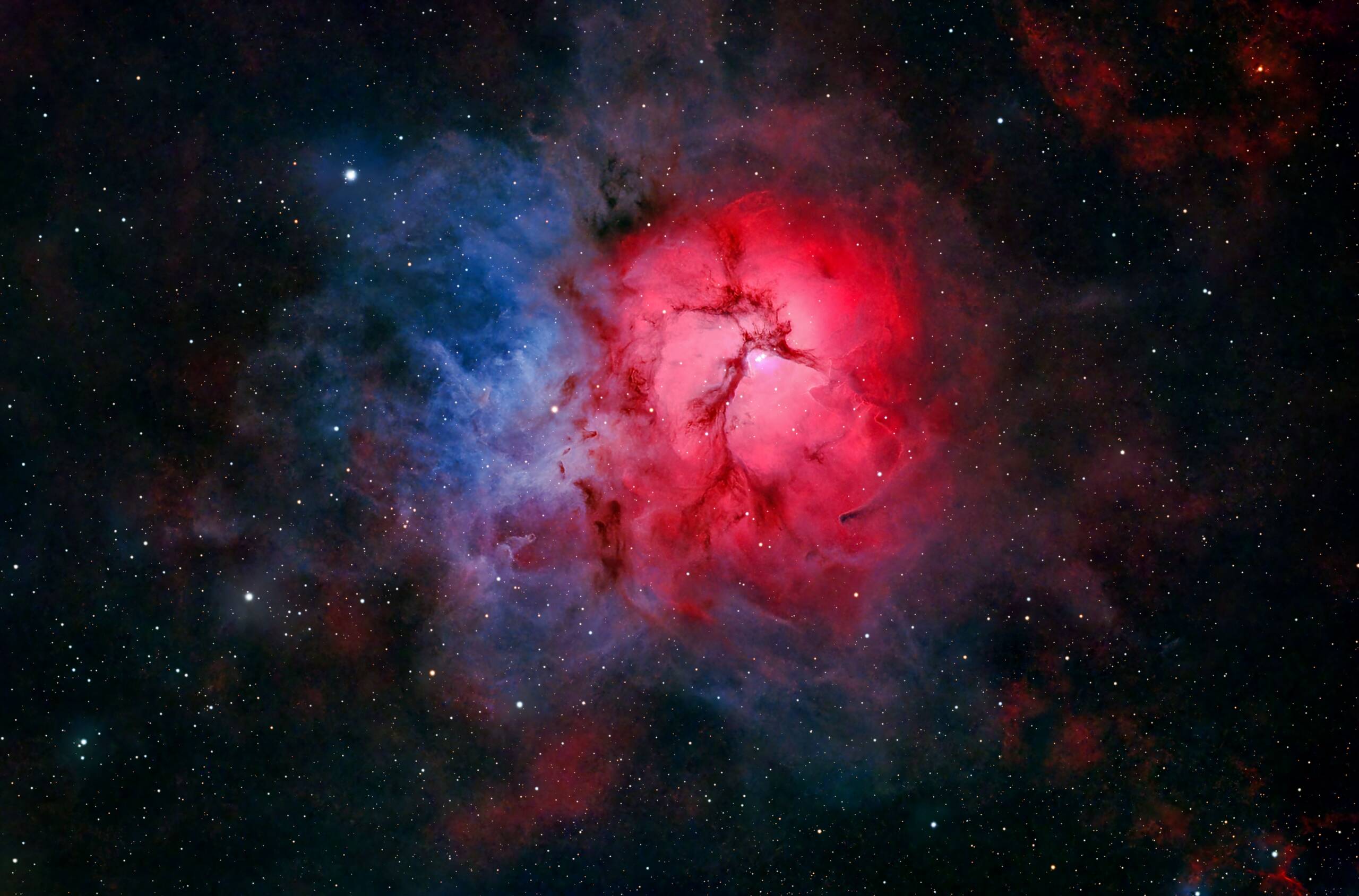
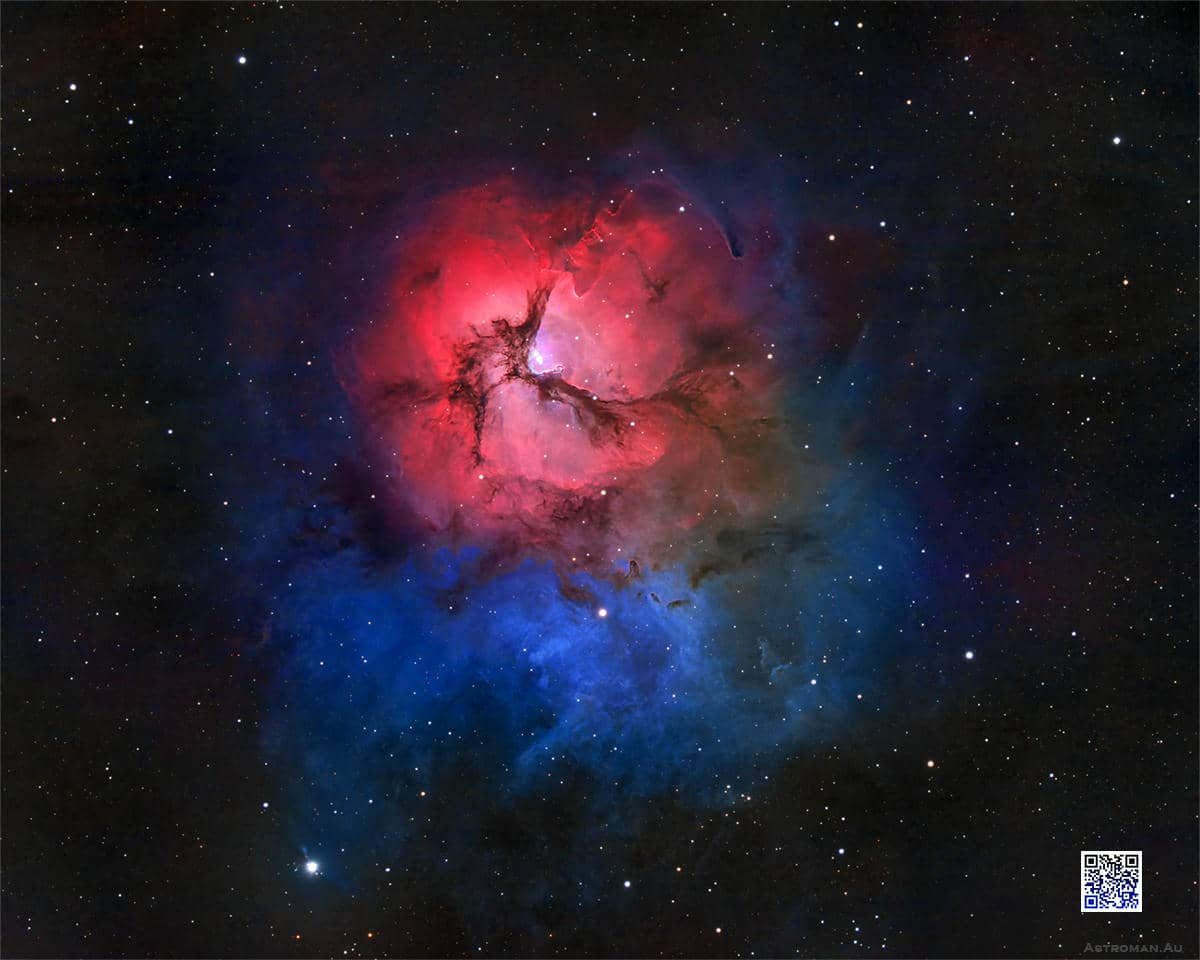
Its famous name, Trifid, comes from the Latin trifidus, meaning “divided into three parts.” Dark lanes of dense interstellar dust slice through the luminous centre, creating the distinctive three-lobed structure that has made the Trifid one of the most recognisable deep-sky objects in the southern sky.
But the deeper you look, the more there is to discover.
The Colours Tell the Story
The Trifid is a natural demonstration of how different forms of light reveal different physical processes.
The intense red and pink emission comes primarily from ionised hydrogen. Ultraviolet radiation from young, energetic stars strips electrons from hydrogen atoms; as the atoms recombine, they emit light that reveals the surrounding stellar nursery.
The striking blue region tells a different story. Here, light from nearby stars is scattered by microscopic dust particles, creating a reflection nebula that shines with the reflected light of its young stars.
Then there are the dark lanes—dense clouds of cooler dust lying between us and the glowing nebula. They absorb and block the light behind them, creating the dramatic divisions that give M20 its name.
Three different phenomena—emission, reflection and absorption—come together in a single cosmic landscape.
A Stellar Nursery in Motion
The Trifid Nebula spans roughly 50 light-years and is an active region of star formation.
Deep within its clouds, gravity is gathering gas and dust into increasingly dense concentrations that can eventually collapse to form new stars. At the same time, radiation and stellar winds from existing young stars are pushing back against the surrounding material, sculpting the nebula into intricate ridges, pillars and filaments.
The result is a cosmic environment where stars are being born while their surroundings are simultaneously being reshaped by the stars themselves.
The Trifid is therefore not a static cloud frozen in space. It is a dynamic stellar ecosystem evolving across immense distances and timescales.
A Cosmic Time Capsule
The light captured in this photograph has travelled approximately 5,200 years to reach Earth.
The photons recorded by the telescope began their journey long before modern astronomy existed and during an era when the earliest great civilisations were emerging on Earth.
When you look at M20, you are therefore looking into the past.
The photograph captures not merely a distant object, but a moment in the continuing history of our Milky Way—a stellar nursery seen across thousands of years of space and time.
From Photons to Photograph
Creating this image required patience, precision and many hours beneath the night sky.
A 400mm triplet telescope paired with a cooled high-definition colour astronomy camera was used to collect hundreds of long exposures across several clear nights. Each exposure accumulated a small amount of the faint light arriving from the nebula; together, they built a detailed record of its intricate structure.
Narrowband imaging was used to isolate specific wavelengths of nebular emission, revealing subtle structures within the glowing gas, while additional imaging preserved the natural character of the stars and reflected light.
The resulting data was carefully calibrated, integrated and processed using Astro Pixel Processor, PixInsight and Adobe Photoshop. The challenge was to enhance the extraordinary colour and structure within M20 without losing the natural relationship between its glowing gas, reflected starlight and dark dust.
The Astrophotographer’s Perspective
The Trifid Nebula is a reminder that colour in astrophotography is not merely decorative.
Every colour has a story.
The red reveals glowing hydrogen. The blue carries the reflected light of young stars. The dark lanes reveal dense clouds of cosmic dust. Together they allow us to see processes occurring across tens of light-years—processes that would otherwise remain almost entirely invisible to the human eye.
My aim with this image was to capture that extraordinary combination of science, structure and beauty and present M20 not simply as a familiar astronomical object, but as a living landscape shaped by the birth and evolution of stars.
The Artwork
The Trifid Nebula is nature’s own celestial canvas—a place where glowing gas, reflected starlight and dark cosmic dust come together to create an extraordinary work of natural art.
Presented as a premium fine-art print, this image brings the colour and complexity of a distant stellar nursery into an interior environment.
Its rich palette and intricate structure reward close viewing, while its scientific story gives the artwork a depth that extends far beyond its visual beauty.
For collectors, astronomy enthusiasts and interior designers, M20 offers both visual impact and a story worth discovering.
Three colours of cosmic light. Three faces of a stellar nursery. One extraordinary landscape, captured from Earth.
Need Help Choosing? Let’s Find the Right Fit.
Send us a message with your specs or questions, and we'll guide you through the options.Related products
-
 Price range: $25.00 through $399.00 This product has multiple variants. The options may be chosen on the product page
-
 Price range: $25.00 through $399.00 This product has multiple variants. The options may be chosen on the product page