Helix Nebula — God’s Eye
Click here to learn more.

Description
Description
The Wonder
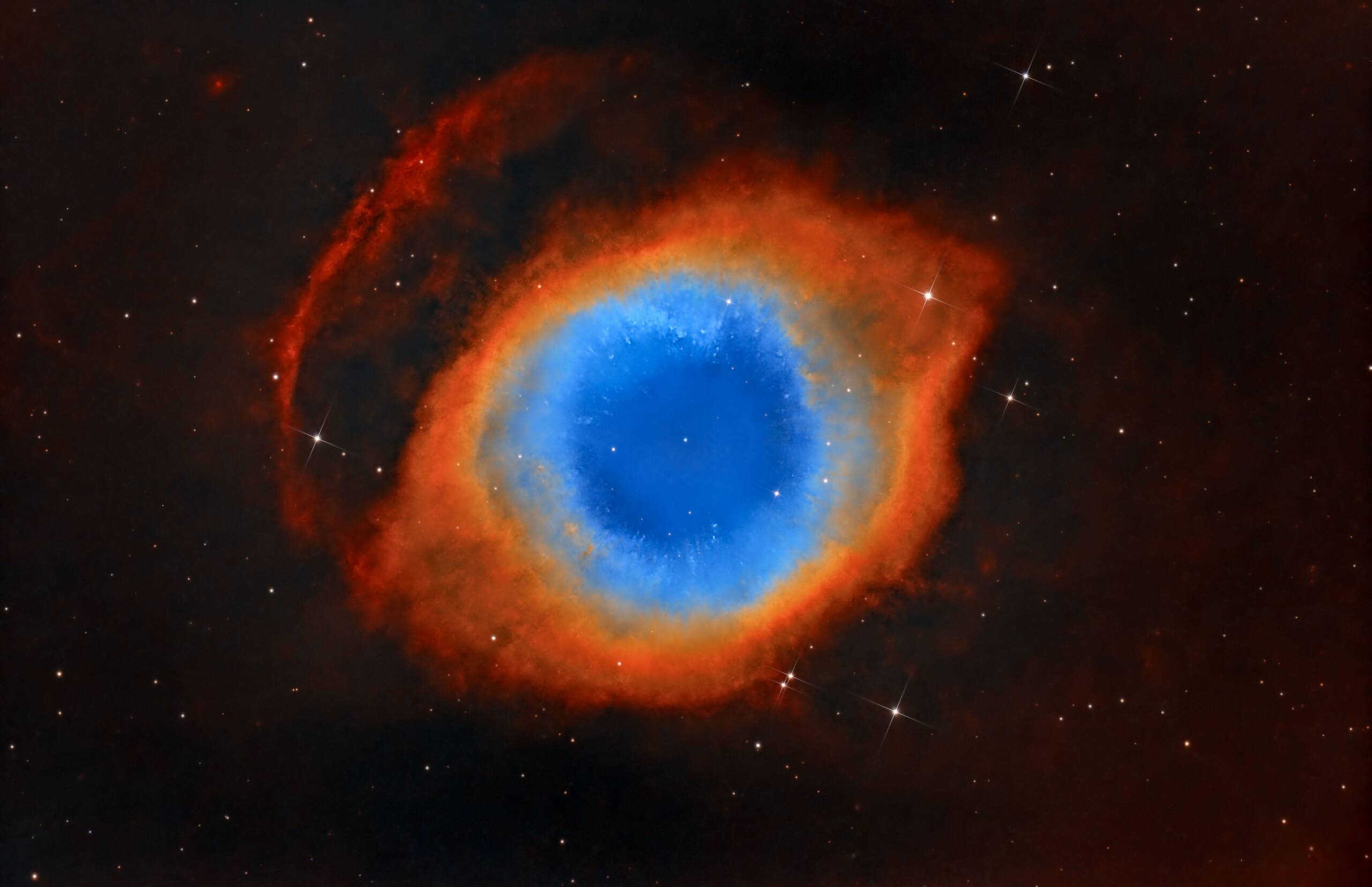
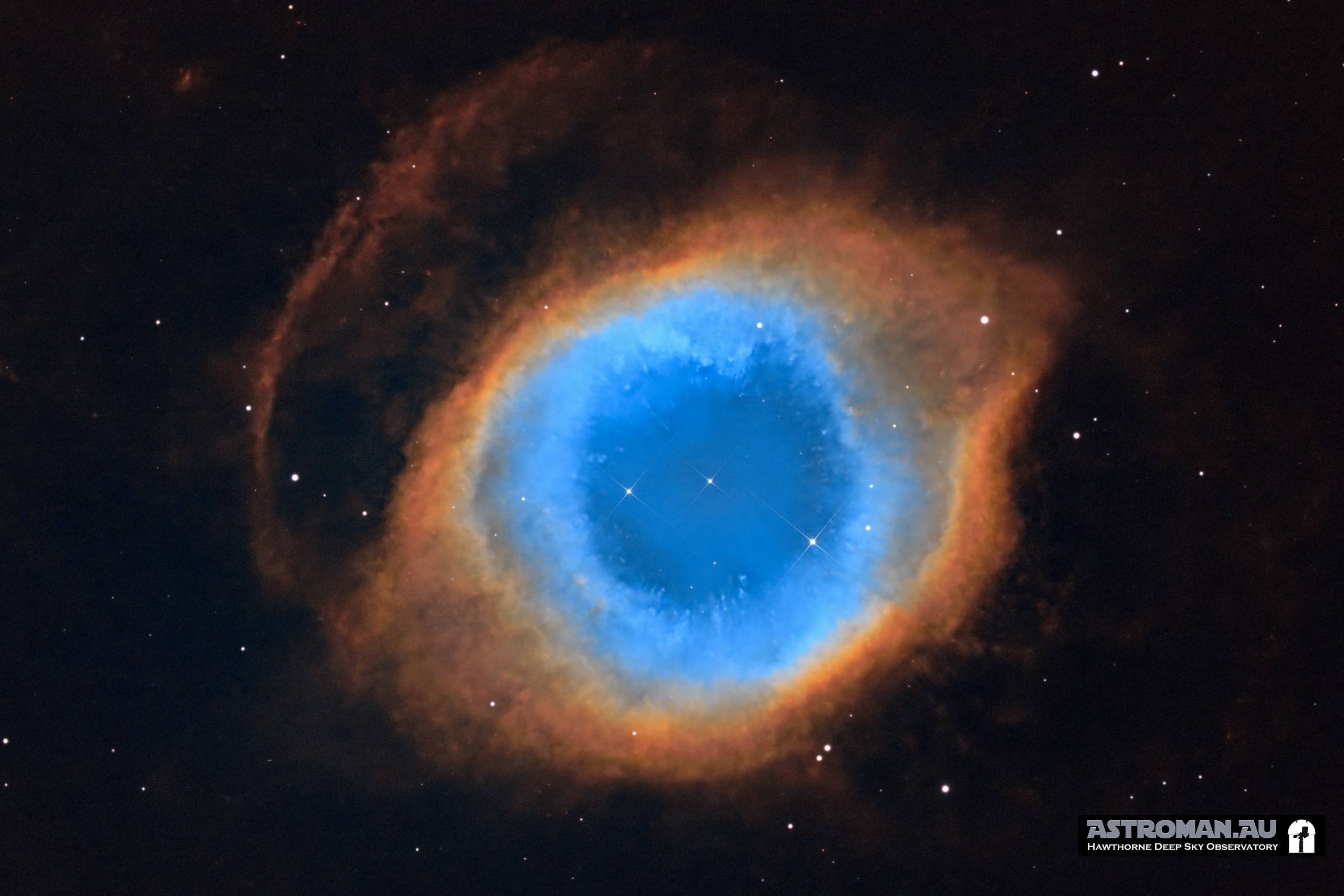
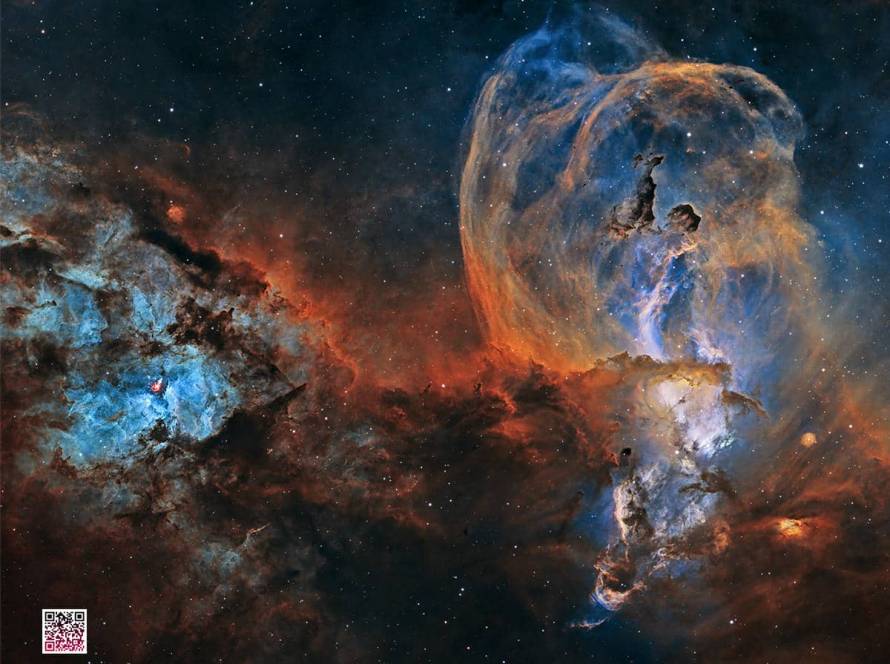
Few sights in the night sky are as captivating as the Helix Nebula, popularly known as “God’s Eye.”
Located approximately 650 light-years away in the constellation Aquarius, this extraordinary planetary nebula is the expanding remains of a Sun-like star nearing the end of its life.
Its remarkable eye-like appearance is created by enormous shells of glowing gas released by the dying star. What looks like a celestial eye is, in reality, a star returning its outer layers to space.
The Life Cycle of a Star
The Helix offers us a glimpse into the distant future of our own Sun.
For billions of years, a Sun-like star converts hydrogen into helium through nuclear fusion. Eventually, its core runs short of hydrogen and the star expands into a red giant, becoming vastly larger and brighter.
In its final stages, the star sheds its outer atmosphere into space. Intense radiation from the exposed stellar core then illuminates this expanding cloud, creating the spectacular colours and intricate structures we see in the Helix.
At the centre, the remaining stellar core becomes a white dwarf—an incredibly dense, Earth-sized remnant that will slowly cool over billions of years.
A star dies, but its story does not end. Its material returns to space, becoming part of the raw ingredients for future stars and planets.
A Glimpse of Our Sun’s Future
The Sun is currently about 4.6 billion years old and still has several billion years of stable life ahead.
Eventually, it too will expand into a red giant and shed its outer layers, leaving behind a white dwarf.
The Helix is therefore more than a beautiful nebula.
It is a glimpse into one possible chapter of our own Sun’s distant future.
From Light to Photograph
The Helix is deceptively challenging to capture. Its delicate outer structures are extremely faint, while the central white dwarf is remarkably bright.
Long-exposure astrophotography and narrowband imaging reveal the subtle emissions from elements such as hydrogen and oxygen, bringing out the intricate rings, filaments and knots hidden within the nebula.
Careful processing then transforms thousands of individual photons into a detailed portrait of a star’s final transformation.
The Astrophotographer’s Perspective
The Helix reminds us that stars are not permanent fixtures in the heavens.
They are born, evolve and eventually return their material to the cosmos.
When I look at this image, I see more than an extraordinary celestial eye. I see a star completing its life cycle—and a distant preview of what awaits our own Sun.
The Artwork
Helix Nebula — God’s Eye combines striking visual beauty with a profoundly human story.
Its eye-like form immediately draws the viewer in, while the science behind it rewards a closer look.
A star’s final breath.
A cosmic eye opening 650 light-years away.
A glimpse of our Sun’s distant future
Related products
-
 Price range: $25.00 through $399.00 This product has multiple variants. The options may be chosen on the product page