

Fighting Dragons of Ara
Click here to learn more.

Description
Description
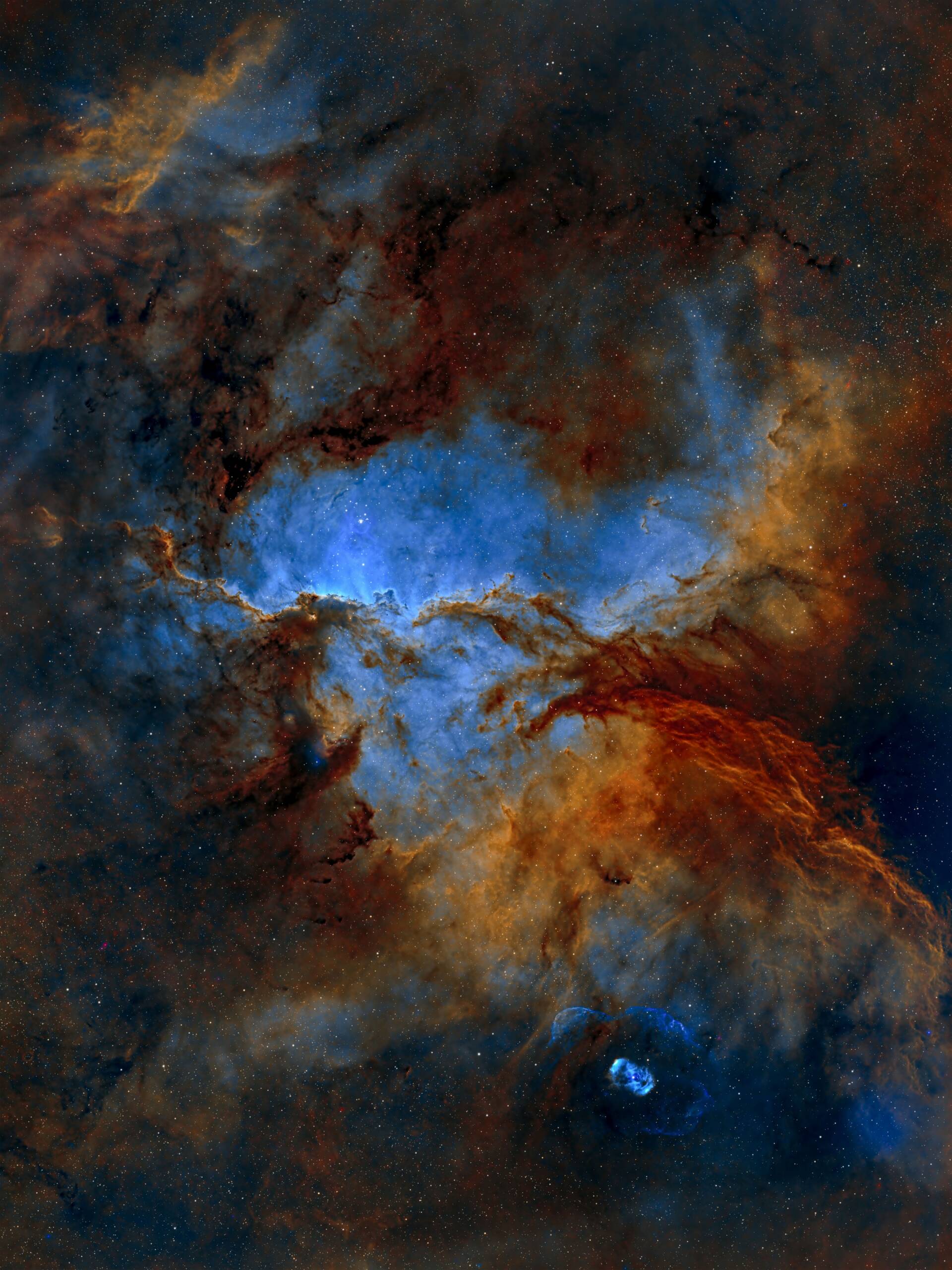
NGC 6188 — A cosmic drama sculpted by stars
There are places in the universe where science and imagination seem to meet.
Four thousand light-years from Earth, in the southern constellation of Ara — the Altar — enormous clouds of gas and dust have been sculpted into one of the most dramatic sights in the night sky. Known as NGC 6188, this emission nebula has earned the evocative name Fighting Dragons of Ara because the dark, towering structures at its heart resemble two mythical dragons facing one another.
But the dragons aren’t really there.
What you are seeing is something every bit as extraordinary: a stellar nursery being transformed by the immense energy of young, massive stars.
A landscape shaped by stellar power
NGC 6188 is an active star-forming region approximately 4,000 light-years from Earth. The nebula stretches across hundreds of light-years, forming part of a much larger complex of gas and dust in the Milky Way.
At its heart is the young open star cluster NGC 6193. Its hot, massive stars pour out intense ultraviolet radiation and powerful stellar winds. These forces interact with the surrounding molecular cloud, ionising the hydrogen and sculpting the dense dust into dramatic ridges, pillars and dark silhouettes.
The result is a landscape that looks almost alive.
The glowing regions reveal where energetic radiation is exciting the gas. The dark structures are dense concentrations of cosmic dust, blocking light from behind and creating the extraordinary contrast that gives the dragons their form.
The resemblance to mythical creatures is an example of pareidolia — our brain’s natural tendency to recognise familiar shapes in complex patterns. Yet the science behind the shapes is every bit as fascinating as the mythology they inspire.
Imagine looking back 4,000 years
There is another remarkable dimension to this photograph.
The light recorded in this image began its journey towards Earth approximately 4,000 years ago.
When you look at this artwork, you aren’t seeing NGC 6188 as it exists today. You are seeing it as it appeared thousands of years in the past — at a time when ancient civilisations were developing some of humanity’s earliest cities, monuments and written cultures.
Astrophotography gives us a remarkable form of time travel.
Every photon in this photograph has crossed an almost unimaginable distance before finally arriving at a telescope in Brisbane.
From Brisbane to the stars
This image began not in a professional observatory, but at my own Hawthorne Deep Sky Observatory in Brisbane.
Capturing faint deep-sky objects from an urban environment presents a very different challenge from photographing the night sky from a remote dark-sky location. Brisbane’s light pollution brightens the background sky, while atmospheric turbulence, humidity, clouds and the limited time each target is visible all work against the photographer.
The solution is patience, precision and the ability to collect extremely faint signals over many exposures.
Rather than taking a single photograph, an astrophotograph such as this is constructed from a sequence of carefully calibrated exposures. Each frame records another small amount of information from the nebula. Individual exposures are then aligned and combined to increase the signal-to-noise ratio, revealing structures that are far too faint to appear in a conventional photograph.
The capture
Object: NGC 6188 — Fighting Dragons of Ara
Constellation: Ara
Distance: Approximately 4,000 light-years
Object type: Emission nebula / star-forming region
Captured from: Hawthorne, Brisbane, Australia
Telescope: ASKAR FRA 400 with 0.7x reducer
Camera: ASI2600mc Pro cooled camera (-10 degrees)
Filters: Optolong L-Ex, L-Pro and OIII-SII filters (Channel extraction and SHO combined)
Total integration: 23 hours
Image processing: Astro Pixel Processor / PixInsight / Photoshop
The hidden colours of the universe
One of the most fascinating aspects of astrophotography is that the final image can reveal information that our eyes cannot see.
The nebula emits light at specific wavelengths associated with different elements and physical processes within the gas. Specialised astronomical filters allow these extremely narrow wavelengths to be isolated and recorded.
This makes astrophotography more than simply photographing a beautiful object.
It is a process of collecting physical information from the universe and translating it into an image that we can see and appreciate.
The colour palette used in this artwork has been carefully developed to reveal the intricate structure of the nebula while preserving its natural sense of depth, texture and three-dimensionality.
Behind the image
Creating an image like Fighting Dragons of Ara is a process of discovery rather than simply pressing a shutter.
The telescope must track the Earth’s rotation with extraordinary precision. The camera records faint photons while the system remains exposed for minutes at a time. Each exposure is then assessed for tracking errors, focus, atmospheric conditions and other imperfections.
The best frames are calibrated and combined. The resulting dataset is then processed to reveal the faint structures hidden within the original data.
Processing is particularly important in astrophotography. The objective isn’t to manufacture detail that isn’t there. It is to carefully extract and present information that is already contained within the captured photons.
That final stage is where science meets artistry.
Contrast, colour balance, star control, dynamic range and composition all influence how the viewer experiences the image. The aim is to create something scientifically grounded while also allowing the extraordinary beauty of the subject to speak for itself.
A piece of the universe for your space
Large astrophotographic artworks can bring something quite different to an interior.
They introduce scale, depth, colour and a sense of wonder without relying on conventional landscape or architectural imagery. A nebula can become a dramatic focal point in a residential interior, hospitality environment, corporate space, healthcare setting or contemporary office.
Fighting Dragons of Ara is particularly suited to interiors where a strong statement is desired. Its sweeping structures, contrasting dark dust and luminous gas create a visual composition that can be appreciated from across a room while rewarding closer inspection with intricate detail.
For interior designers, architects and decorators, the artwork is available in a range of professionally produced formats and sizes to suit different spaces and design concepts.
Available formats: [Canvas / Acrylic / Metal / Other]
Custom sizing and framing options: please contact us
Look closer
What initially appears to be two dragons is actually a vast stellar nursery, shaped by some of the most powerful forces in the galaxy.
Look closely and you begin to see pillars of dust, glowing hydrogen, young stars and layers of structure extending across an immense region of space.
And then step back.
The dragons return.
That combination of science, imagination and visual beauty is what makes Fighting Dragons of Ara one of my favourite cosmic subjects.
The universe, captured from Brisbane.
Astroman.au
The Universe Captured Through the Lens
Need Help Choosing? Let’s Find the Right Fit.
Send us a message with your specs or questions, and we'll guide you through the options.Related products
-
 Price range: $25.00 through $399.00 This product has multiple variants. The options may be chosen on the product page