Star Trails — Earth in Motion
Click here to learn more.

Description
Description
The Sky Appears to Move
On a clear night, the stars appear timeless and unmoving.
But they are not.
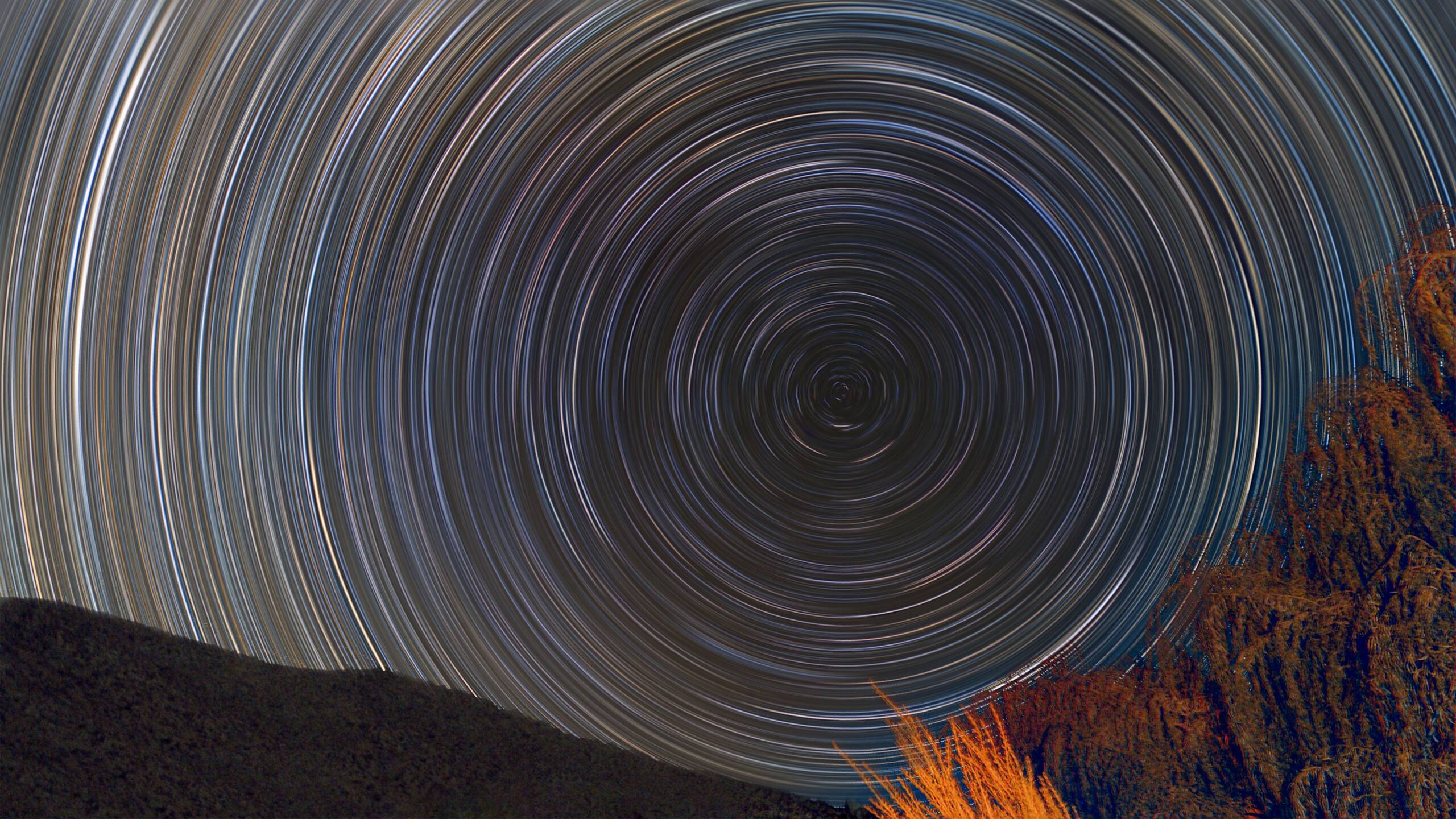
The graceful arcs in this photograph are a direct visual record of our planet rotating through space. The stars appear to sweep across the sky because the Earth beneath us is continuously turning on its axis.
At the centre of this image lies the South Celestial Pole—the point in the southern sky around which the stars appear to rotate.
The longer the exposure sequence continues, the more clearly the movement of the Earth reveals itself.
What appears to be a moving sky is, in reality, a portrait of our planet in motion.
The Southern Sky in the Atacama
This image was captured from the Elqui Valley in Chile’s Atacama Region, one of the world’s great destinations for astronomical observation.
Far from the light pollution of major cities, the Atacama offers exceptionally dark and clear skies. The region is home to some of the world’s most important astronomical facilities, where powerful telescopes explore the universe from locations chosen precisely because of these extraordinary conditions.
Standing beneath such a sky creates a remarkable sense of perspective.
The Milky Way stretches overhead. Thousands of stars become visible to the naked eye. And when a camera is pointed towards the South Celestial Pole, the rotation of the Earth becomes almost impossible to ignore.
The Celestial Compass
Unlike the northern sky, which has the easily recognised North Star, the southern sky has no equally bright star marking the celestial pole.
Instead, the South Celestial Pole lies within the constellation of Octans, surrounded by a field of stars that appear to rotate around it.
In this photograph, the pole becomes the natural centre of the composition.
The stars closest to it form tight arcs.
Those farther away trace progressively larger circles.
Together, they create a celestial fingerprint of Earth’s rotation.
A Planet in Motion
The Earth rotates once approximately every 24 hours.
We do not feel this motion because everything around us—including the atmosphere, oceans and ourselves—is travelling with the planet.
Yet the movement is measurable.
Star-trail photography transforms that invisible motion into something we can see.
Each individual star appears as a point of light, but when images are captured continuously over an extended period and combined, those points become luminous arcs.
The trails are therefore not artificial effects.
They are the accumulated evidence of Earth’s rotation.
From Photons to Photograph
What makes this image particularly remarkable is how simply it was captured.
Rather than requiring a large observatory telescope or complex tracking system, the photograph was created using a Seestar S30 Pro, a compact portable smart telescope designed to make astronomical imaging remarkably accessible.
The telescope was positioned in the Elqui Valley and carefully oriented directly towards the South Celestial Pole.
A sequence of exposures was then collected as the Earth continued its rotation beneath the stars.
The individual frames were subsequently combined to create the continuous trails seen in the final artwork.
The equipment may be compact, but the phenomenon it records is planetary in scale.
A small telescope beneath one of the world’s darkest skies can reveal the motion of an entire world.
The Astrophotographer’s Perspective
There is something fundamentally different about photographing star trails.
With most astrophotography, the objective is to compensate for the Earth’s rotation—to keep the stars appearing perfectly still and capture them as sharp points of light.
Here, the opposite is true.
The Earth’s rotation becomes the subject.
Instead of freezing the movement of the sky, the camera allows that movement to accumulate into graceful arcs.
For me, this creates a powerful connection between astrophotography and our place on Earth.
The stars seem to move.
The telescope appears to be watching the heavens turn.
But the real movement is beneath us.
We are standing on a rotating planet, travelling through space, while the universe surrounds us.
The Artwork
Star Trails — Earth in Motion is a visual representation of one of the most fundamental movements in astronomy: the rotation of our planet.
Captured across the ocean from Brisbane, in the extraordinary darkness of Chile’s Elqui Valley, the image connects the ancient night sky with modern technology.
The concentric trails draw the viewer towards the South Celestial Pole, creating a natural sense of movement, depth and scale.
For collectors and interior designers, the artwork offers something beyond a beautiful night-sky photograph.
It is a conversation piece—a visual demonstration of planetary motion and our relationship with the cosmos.
Every trail represents time.
Every arc represents the rotation of Earth.
And at the centre of it all is a simple reminder:
we are not standing still.
We are riding a rotating world through an immense and moving universe.
Need Help Choosing? Let’s Find the Right Fit.
Send us a message with your specs or questions, and we'll guide you through the options.Related products
-
 Price range: $25.00 through $399.00 This product has multiple variants. The options may be chosen on the product page