


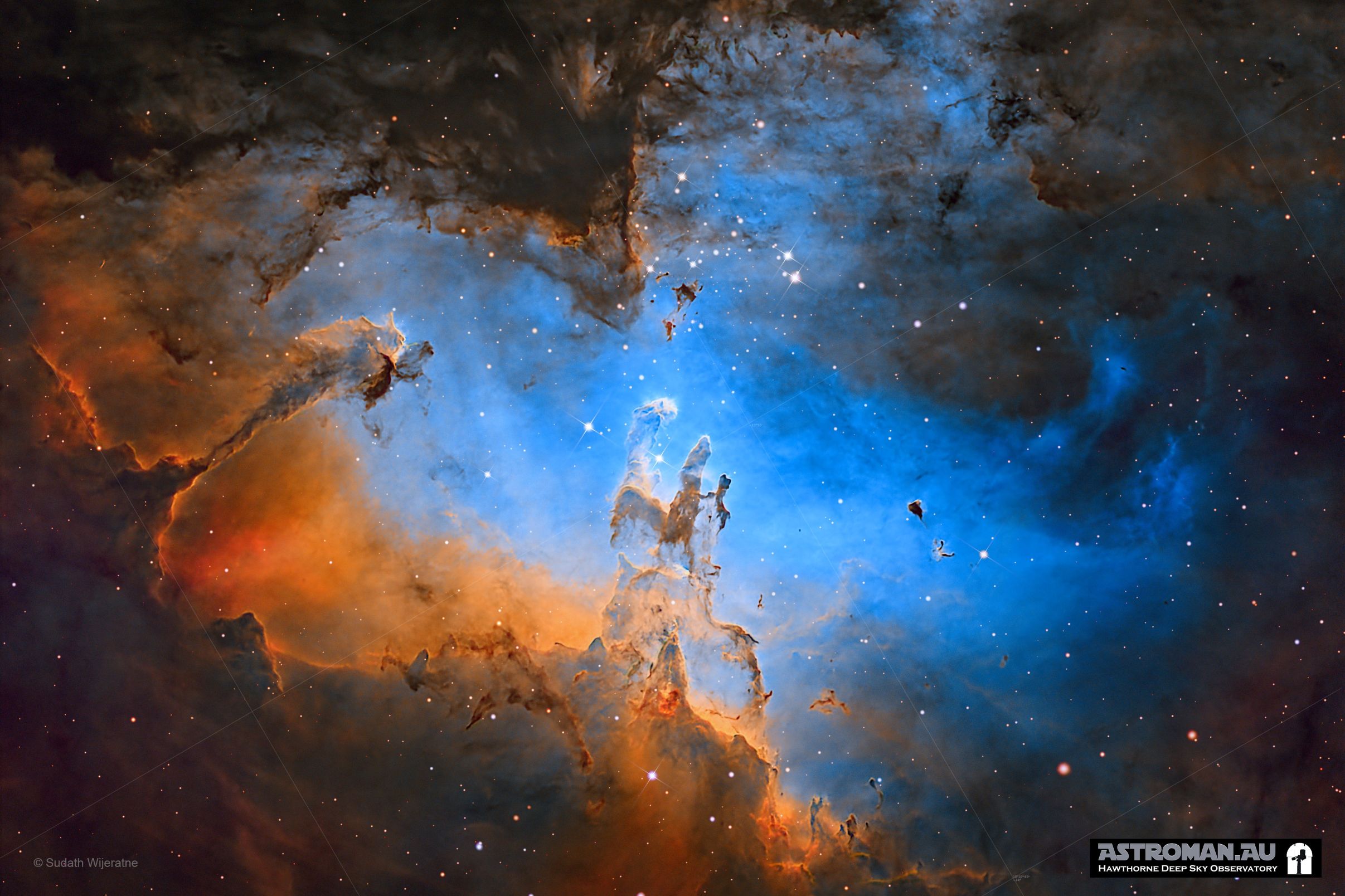

Eagle Nebula — Pillars of Creation
Click here to learn more.

Description
Description
The Wonder
Few sights in the universe are as instantly recognisable as the Pillars of Creation—towering columns of gas and dust rising from the heart of the Eagle Nebula (Messier 16), approximately 6,500 light-years from Earth in the constellation Serpens.
These immense structures are not solid pillars, but dense clouds of cold gas and dust being sculpted by intense radiation and powerful stellar winds from nearby young stars. The tallest extends roughly four to five light-years, making it large enough to span almost the distance from the Sun to the nearest neighbouring star.
This image reveals the intricate architecture within these famous pillars: glowing hydrogen, delicate filaments, dense knots of dust and newborn stars emerging from the darkness.
The Story Behind the Image
The Pillars of Creation are part of a much larger stellar nursery where new stars are forming within the Eagle Nebula. Deep inside the clouds, gravity draws gas and dust together while intense ultraviolet radiation from massive young stars erodes the surrounding material.
This process creates the pillars themselves.
Their illuminated surfaces glow as they are bombarded by radiation, while the densest regions resist erosion and remain as towering columns. At their tips and within their dark interiors, pockets of material continue to collapse under gravity, giving birth to new stars.
It is a remarkable example of stellar creation and destruction occurring simultaneously.
A Cosmic Time Capsule
The light captured in this photograph began its journey approximately 6,500 years ago.
That means we are seeing the Eagle Nebula as it appeared thousands of years in the past. There is an even more fascinating possibility: because the Pillars are so distant, astronomers have suggested that some of the structures we see may already have changed dramatically—or even been destroyed by a powerful stellar event—yet their light has not reached us yet.
In other words, the Pillars of Creation may be a cosmic echo of a landscape that has already changed.
From Photons to Photograph
Creating this image required far more than pointing a telescope towards the Eagle Nebula.
Thousands of individual photons, travelling across interstellar space for millennia, were collected through a combination of carefully planned long-exposure captures. Narrowband imaging was used to isolate the faint emissions of hydrogen, sulfur and oxygen, revealing structures that are largely invisible to the human eye.
The resulting data was calibrated, integrated and meticulously processed using astrophotography techniques designed to preserve the delicate balance between faint nebular structures and the brilliant stars embedded within the scene.
The final image represents not a single exposure, but the carefully assembled result of many hours of observation, processing and refinement.
The Astrophotographer’s Perspective
The Pillars of Creation are a perfect reminder of why astrophotography is so compelling.
At first glance, they appear almost sculptural—an immense cosmic landscape of towering forms and glowing edges. But behind that beauty lies an extraordinary physical story: stars are being born inside the clouds while radiation from existing stars simultaneously tears those same clouds apart.
I wanted this image to reveal that tension—to capture not simply an iconic astronomical object, but a living, evolving environment where the forces of creation and destruction are playing out across light-years of space.
The Artwork
The Pillars of Creation have become one of humanity’s most recognisable views of deep space. Their scale, texture and extraordinary natural forms make them equally compelling as a scientific subject and as a work of visual art.
Presented as a premium fine-art print, this image brings one of the universe’s most remarkable landscapes into an interior environment.
It invites the viewer to pause, look closer and consider the extraordinary fact that the scene before them began its journey to Earth thousands of years ago.
A landscape of stars. A journey through time. A cosmic masterpiece captured from Earth.
Need Help Choosing? Let’s Find the Right Fit.
Send us a message with your specs or questions, and we'll guide you through the options.Related products
-
 Price range: $25.00 through $399.00 This product has multiple variants. The options may be chosen on the product page
 -
 Price range: $25.00 through $399.00 This product has multiple variants. The options may be chosen on the product page
 -
 Price range: $25.00 through $399.00 This product has multiple variants. The options may be chosen on the product page