
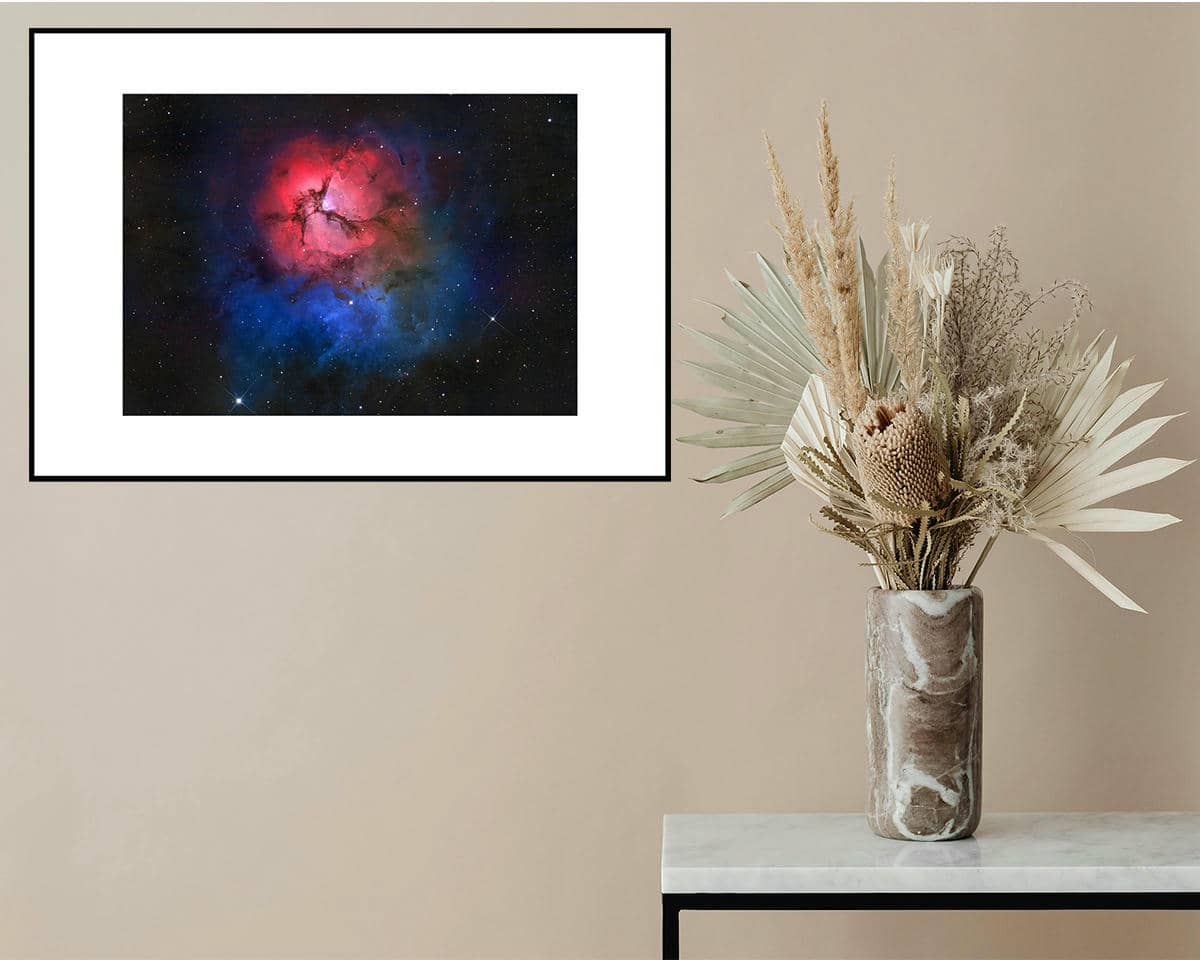
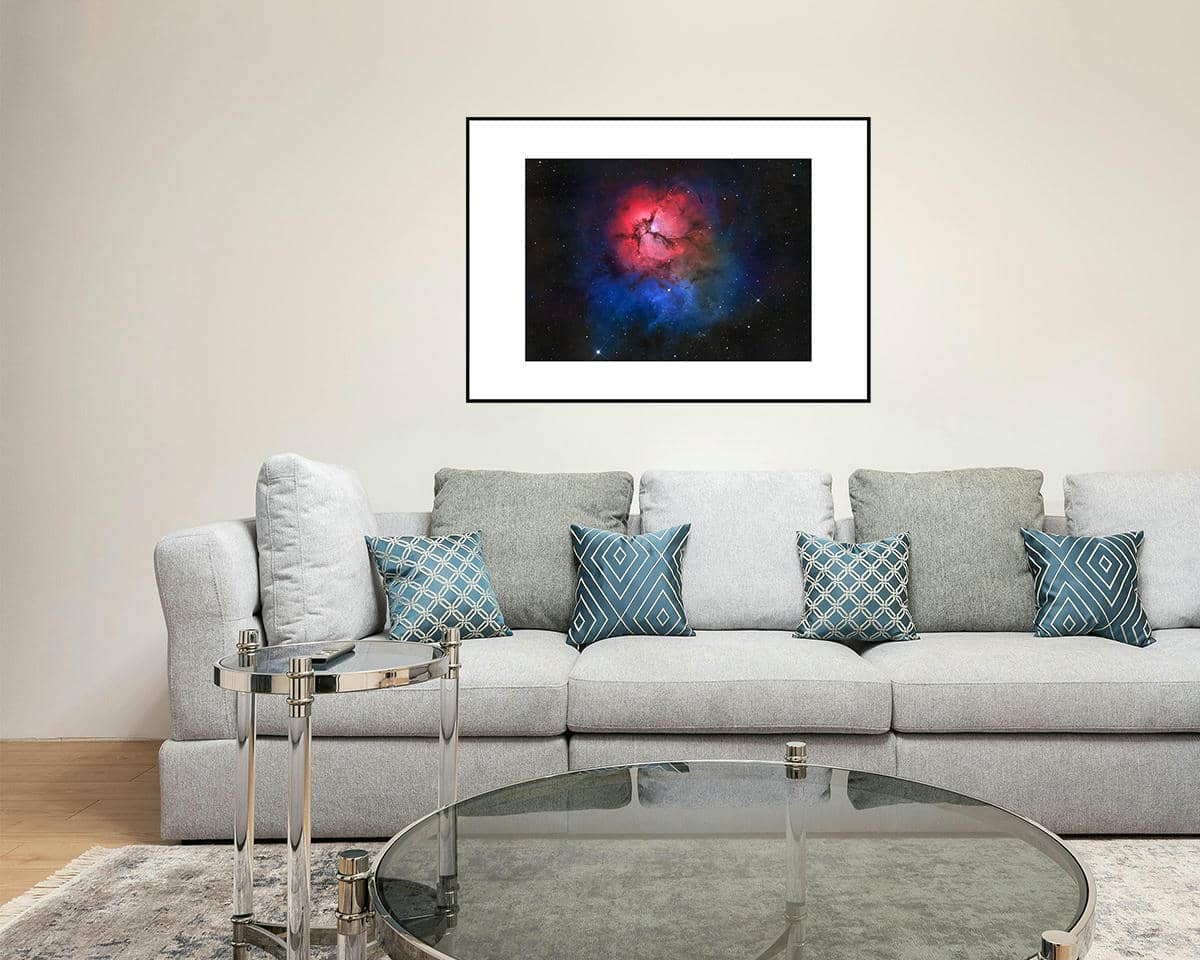
Trifid Nebula (M20)
$25.00 – $399.00
Click here to learn more.

Description
Description
A Celestial Canvas of Color and Light
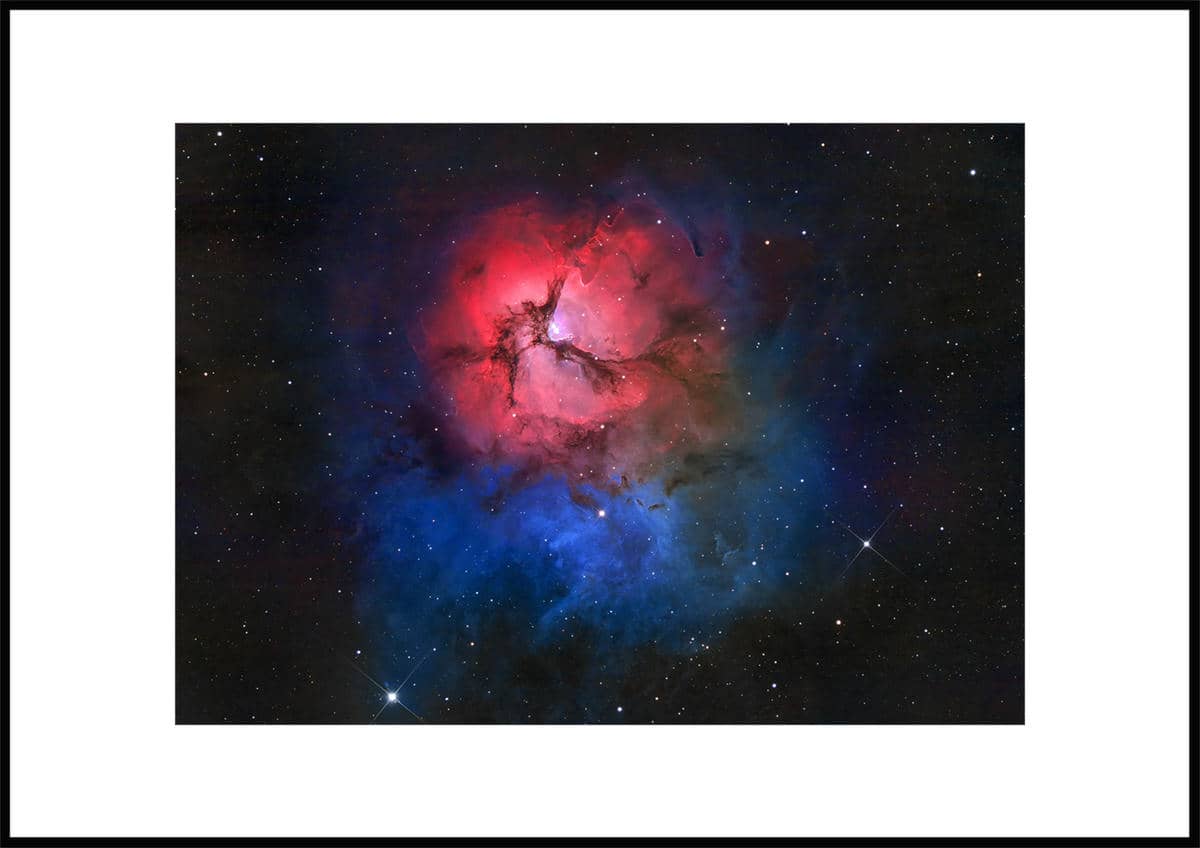
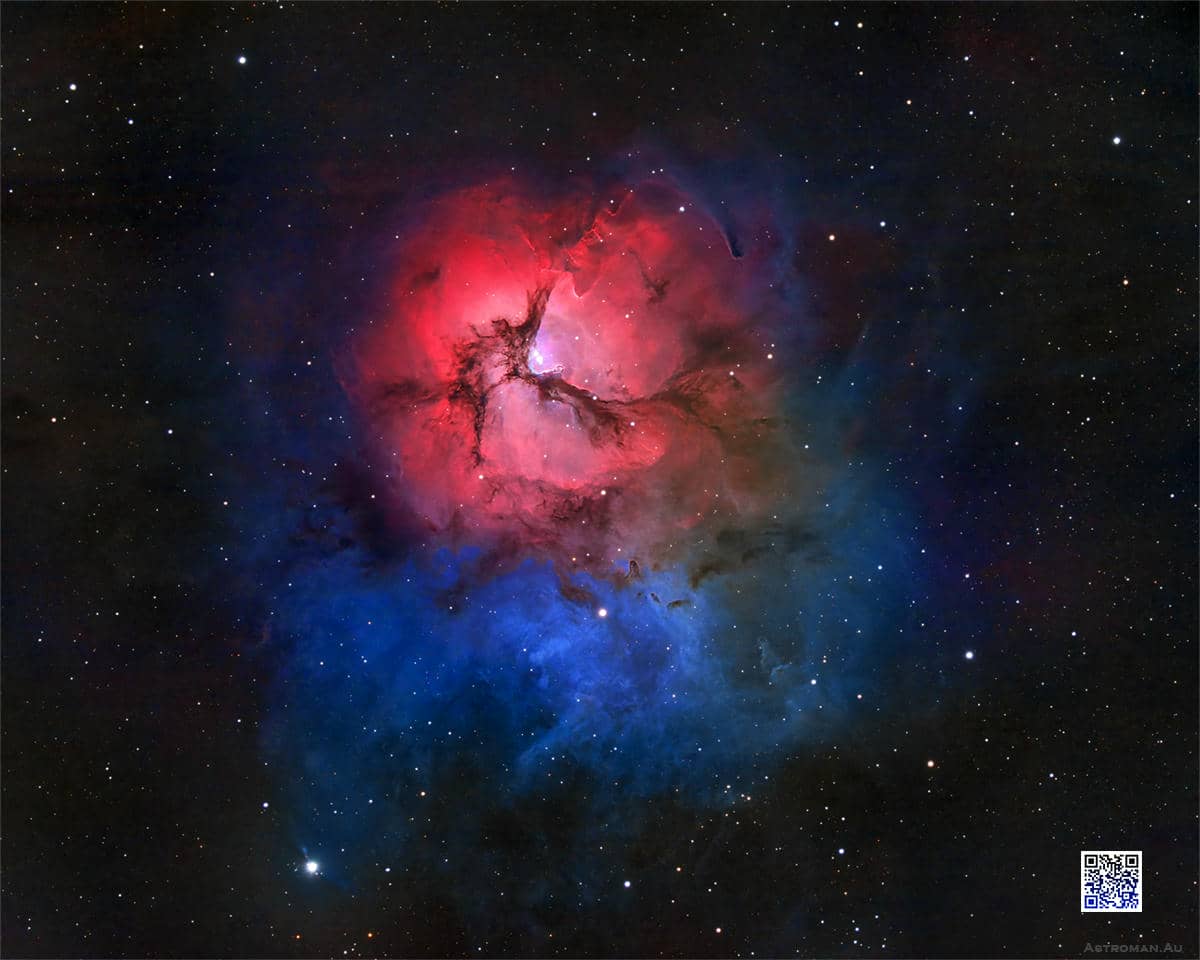
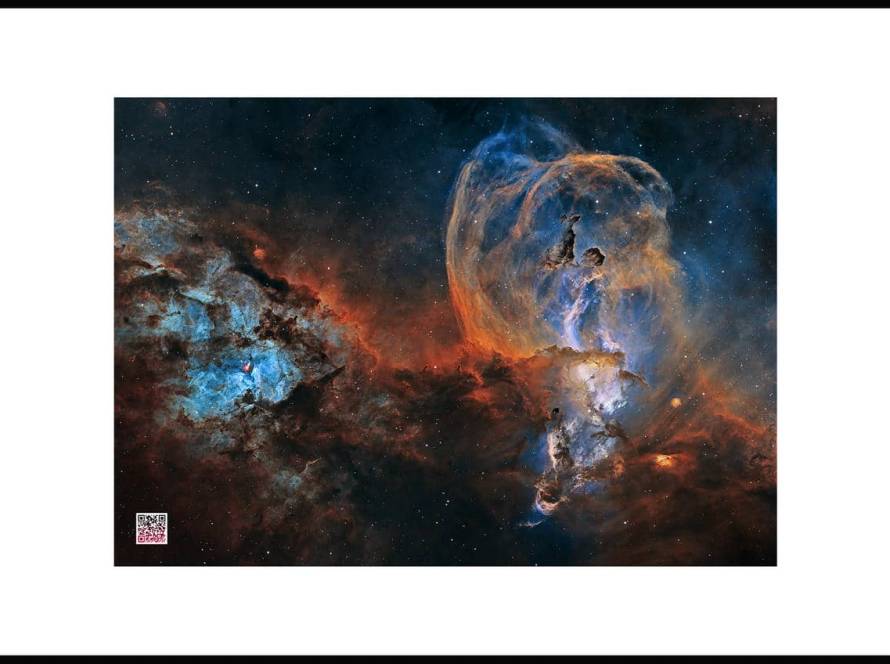
This mesmerising astrophotograph of the Trifid Nebula, also known as Messier 20, captures the beauty and complexity of one of the night sky’s most iconic deep-sky objects. Located around 5,200 light-years away in the constellation Sagittarius, the Trifid Nebula is a remarkable example of a combination nebula—an astronomical phenomenon that includes both emission and reflection regions, as well as intricate dark dust lanes. The name “Trifid” comes from the Latin for “divided into three parts,” which describes the nebula’s distinct structure, with dark lanes cutting through its glowing core and creating a dramatic, three-lobed appearance.
The Trifid Nebula spans approximately 50 light-years and serves as an active stellar nursery, where young stars are forming within dense clouds of gas and dust. Its vibrant colours are produced by the interactions of these new stars with surrounding gases. The pinkish-red regions in the nebula are a result of hydrogen gas being ionised by ultraviolet radiation from massive young stars, while the blue hues come from starlight reflecting off dust particles, characteristic of a reflection nebula. The dark lanes, meanwhile, are composed of cooler, denser regions of dust that obscure the nebula’s light, giving it the “trifid” or three-part appearance. This mix of colours and textures makes the Trifid Nebula a fascinating object to observe and study, showcasing the chaotic beauty of stellar birth and the varied forms nebulae can take.
The light from the Trifid Nebula has travelled over 5,000 years to reach Earth, so we’re observing it as it appeared when ancient civilisations were developing on Earth. This cosmic time capsule offers a window into a star-forming region in the Milky Way, capturing both the beauty of the nebula and the timeless processes that shape our universe.
To create this photograph, hours of exposure time were dedicated over several clear nights. Using a cooled high-definition colour camera (-10°C) attached to a 400mm triplet telescope, hundreds of 5-minute exposures were taken to capture the faint details and vibrant colours of the Trifid Nebula. Narrowband filters were used to isolate specific wavelengths, enhancing the nebula’s fine structures, while a light pollution filter preserved the natural colours of the stars and nebula. Processing in Astro Pixel Processor, PixInsight, and Photoshop allowed for the meticulous enhancement of the colours and intricate details, from the dark lanes that divide the nebula to the radiant clouds of hydrogen and dust that define it.
This high-quality print of the Trifid Nebula is not only a beautiful decorative piece but also an inspiring educational tool. Displayed in a home or office, it invites viewers to explore the marvels of star formation and the dynamic processes of the cosmos, reminding us of the extraordinary forces at work in our own galaxy. This photograph serves as both an artistic masterpiece and a scientific snapshot, a testament to the wonders of the universe and our ability to capture them.
Photo Details
- Date & Time: 2023
- Location: Hawthorne Deep Sky Observatory
- Optics: Celestron EdgeHD 8" with 0.7x reducer
- Camera: ZWO ASI294MM Pro
- Filters: Optolong Ha, R, G and B Pro filters
- Mount: Sky-Watcher EQ6-R Pro
- Composition: Single panel
- Software: Astropixel Processor,, PixInsight, Adobe Photoshop
Reviews (0)
Related products
-
 $25.00 – $399.00 This product has multiple variants. The options may be chosen on the product page
 -
 $25.00 – $399.00 This product has multiple variants. The options may be chosen on the product page
 -
 $25.00 – $399.00 This product has multiple variants. The options may be chosen on the product page
Reviews
There are no reviews yet.