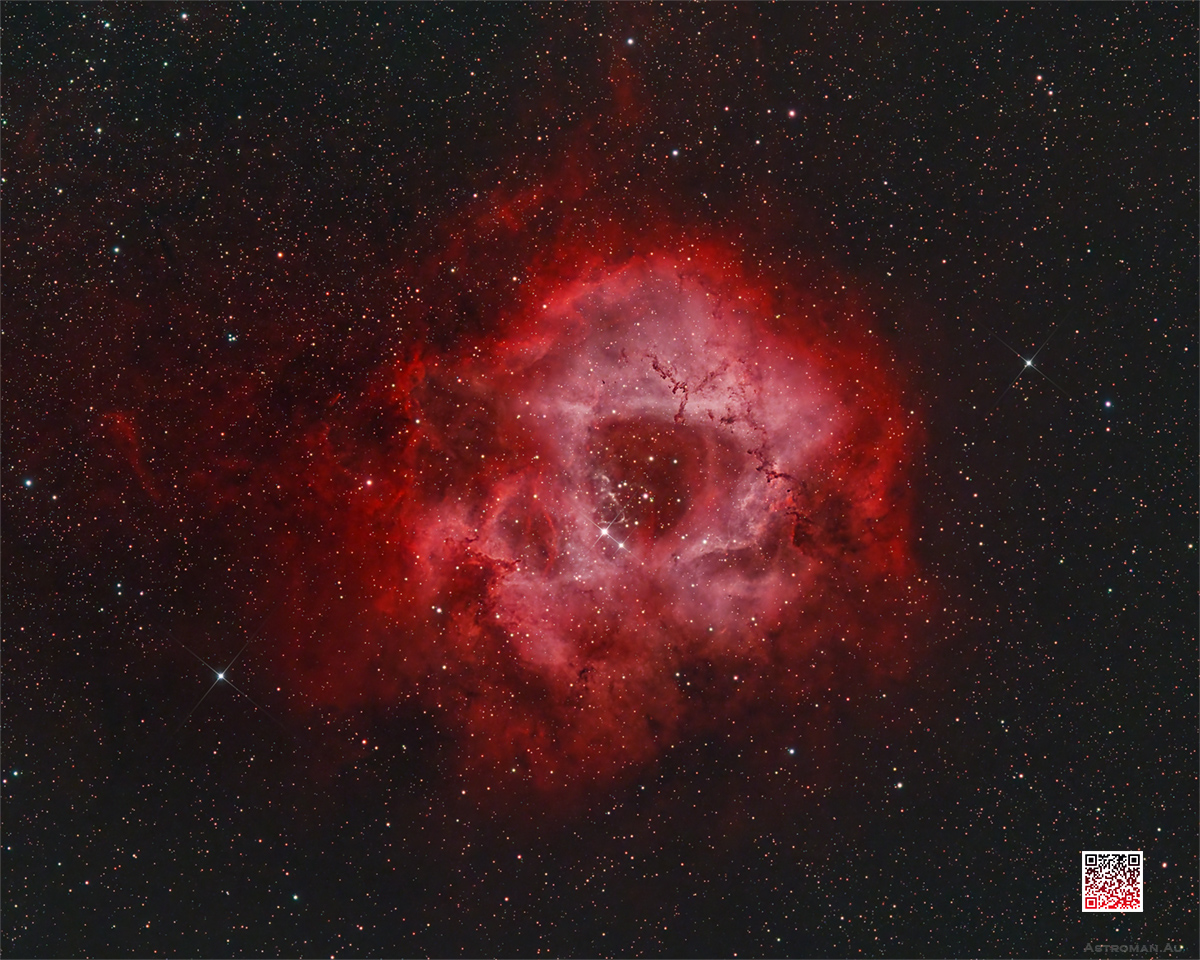
Rosette Nebula — The Lady of the Rose
Click here to learn more.

Description
Description
The Wonder
At first glance, the Rosette Nebula appears to be a magnificent cosmic flower. Look closer, however, and another figure emerges from the glowing clouds—a graceful, almost human-like form standing within the heart of the nebula.
I called her “The Lady of the Rose.”
Located approximately 5,000 light-years away in the constellation Monoceros, the Rosette Nebula is an enormous star-forming region spanning roughly 130 light-years. Its iconic rose-like appearance is created by vast clouds of glowing hydrogen surrounding a relatively open central cavity carved by the intense radiation and stellar winds of young, massive stars.
For this artwork, I moved beyond the familiar wide-field view of the Rosette and focused on its intricate interior using a Celestron EdgeHD 11-inch telescope. The long focal length transforms the familiar nebula into a much more intimate portrait, revealing delicate structures that can easily disappear within the larger composition.
The Lady Within the Rose
Hidden among the glowing clouds is the figure that inspired the title.
The Lady of the Rose is not a separate astronomical object, of course. She is a fleeting visual impression created by the complex interaction of luminous gas, dark dust and the sculpting forces of young stars.
Her apparent silhouette emerges from the surrounding nebula almost like a figure painted by nature itself.
This is one of the joys of astrophotography: distant cosmic structures can evoke familiar forms, allowing science and human imagination to meet in the same image.
A Stellar Nursery
Behind the beauty lies an extraordinary process of cosmic creation.
The Rosette is an active stellar nursery where enormous clouds of gas and dust are collapsing under gravity to form new stars. Powerful ultraviolet radiation from the young stars energises the surrounding hydrogen, causing it to emit the characteristic red glow captured in this image.
At the same time, stellar winds sweep through the surrounding material, carving cavities and sculpting pillars, ridges and intricate filaments.
The nebula is therefore constantly changing—a vast natural sculpture being shaped by the stars born within it.
A View Through Time
The light captured in this photograph began its journey approximately 5,000 years ago.
The photons collected by the telescope have travelled across the Milky Way for millennia before finally reaching Earth and becoming part of this artwork.
When you look at the Rosette, you are therefore looking into the past—a snapshot of a stellar nursery as it appeared thousands of years ago.
From Photons to Photograph
Capturing the delicate structure of the Rosette’s interior required the resolving power of a Celestron EdgeHD 11-inch telescope and the patience of long-exposure astrophotography.
Rather than photographing the entire Rosette, the telescope was used to concentrate on a smaller region of the nebula, allowing subtle filaments, dust structures and variations in the glowing gas to emerge.
Specialised narrowband imaging isolates the faint emissions of hydrogen-alpha (Hα), sulfur (SII) and oxygen (OIII). These data reveal structures that are largely invisible to the human eye and allow the physical complexity of the nebula to be explored in extraordinary detail.
The captured frames were carefully calibrated, integrated and processed using Astro Pixel Processor, PixInsight and Adobe Photoshop, with particular attention given to preserving the delicate structures that form the face and figure of the Lady.
Recognition Beyond Earth
This particular view of the Rosette Nebula received recognition beyond the astrophotography community when it was selected for publication on NASA’s Astronomy Picture of the Day Instagram page.
For me, that recognition was especially meaningful because the image demonstrates what astrophotography can do at its best: reveal something scientifically real while simultaneously creating an emotional and imaginative connection with the viewer.
The Astrophotographer’s Perspective
The Rosette is one of the most photographed nebulae in the night sky. My challenge was to find something within it that had not immediately revealed itself to me.
The 11-inch telescope provided the opportunity to look deeper into the nebula rather than simply capture its familiar rose-shaped outline.
And there she was.
The Lady of the Rose emerged from the interplay of light and shadow—a reminder that the universe can create forms that stimulate both scientific curiosity and human imagination.
The Artwork
This close-up interpretation of the Rosette Nebula transforms a familiar astronomical icon into something more intimate and mysterious.
The Lady of the Rose invites the viewer to look closely, discover the figure within the clouds and then step back to contemplate the immense scale of the stellar nursery surrounding her.
For an interior, it offers a distinctive combination of scientific authenticity, artistic mystery and visual elegance—a cosmic portrait that rewards repeated viewing.
A rose born among the stars. A lady sculpted by light. A cosmic figure captured across 5,000 light-years.
Need Help Choosing? Let’s Find the Right Fit.
Send us a message with your specs or questions, and we'll guide you through the options.Related products
-
 Price range: $25.00 through $399.00 This product has multiple variants. The options may be chosen on the product page
 -
 Price range: $25.00 through $399.00 This product has multiple variants. The options may be chosen on the product page