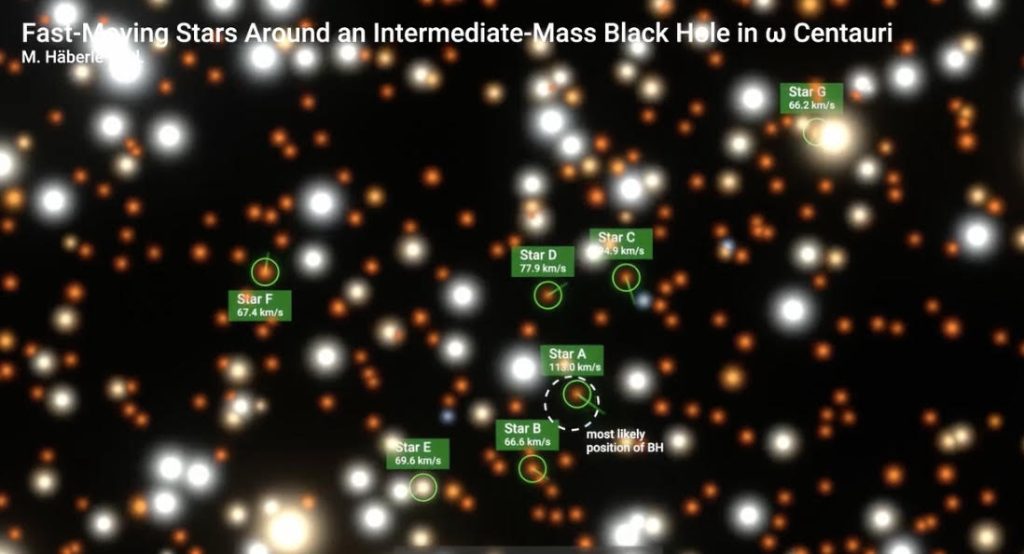
A team of astronomers has analyzed over 500 images from 20 years of NASA’s Hubble Space Telescope observations and found evidence of an intermediate-mass black hole by tracking seven fast-moving stars in the Omega Centauri globular star cluster.
They identified these seven fast-moving stars near the core of the cluster, orbiting around a black hole with a mass equivalent to at least 8,200 suns.
Over the years, the Hubble Telescope has used Omega Centauri to celebrate various milestones. This data might have been collected unintentionally during those observations.
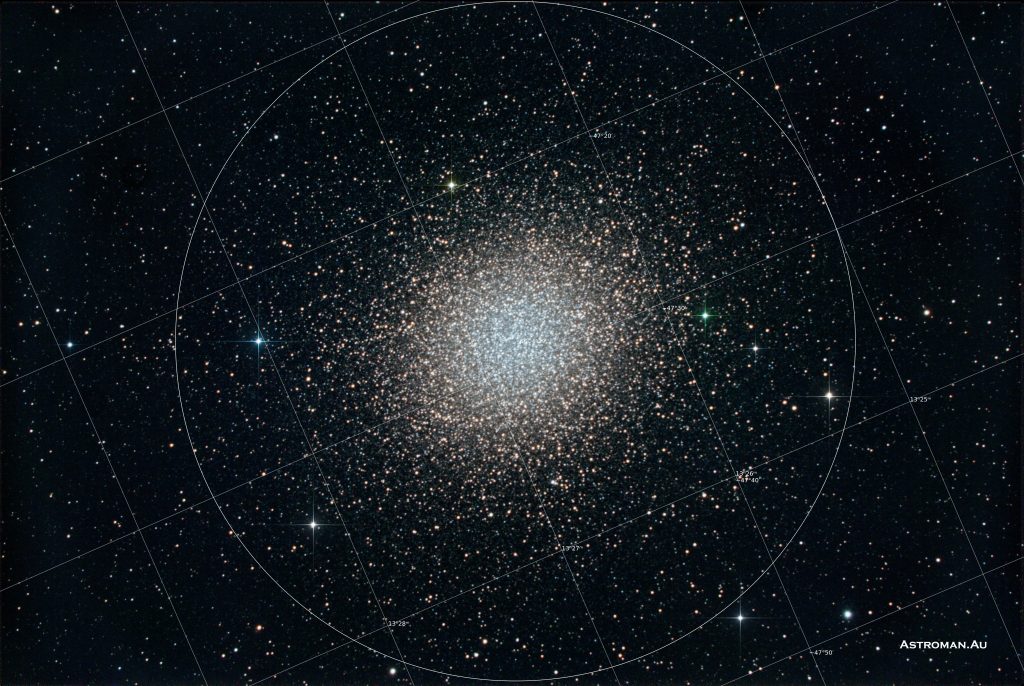
Located 17,710 light-years away, Omega Centauri is closer to Earth than the Milky Way’s supermassive black hole, which lies about 26,000 light-years away at the galaxy’s center. This makes the black hole in Omega Centauri a prime example of an intermediate-mass black hole (IMBH) in our cosmic neighbourhood.
Omega Centauri is one of the few globular clusters visible to the naked eye and appears almost as large as the full moon when seen from a dark, rural area. As the largest known globular star cluster in the Milky Way, it contains about 10 million stars and spans a diameter of approximately 150 light-years. This massive cluster, also known as NGC 5139, is truly a sight to behold.
Interesting Fact: Omega Centauri may have once been the core of a separate galaxy that merged with the Milky Way, losing all but its central batch of stars in the process. This leftover galactic core and its central black hole would be “frozen in time,” with no further mergers and no way for the black hole to grow. This preservation offers a glimpse into the transition between early low-mass black holes and the later supermassive black holes.