Triangulum Galaxy — A Galaxy Alive With Star Birth
Click here to learn more.

Description
Description
The Wonder
At first glance, the Triangulum Galaxy (Messier 33) appears to be a delicate spiral floating quietly in the darkness.
Look closer, and an entirely different story emerges.
Located approximately 2.7 million light-years from Earth in the constellation Triangulum, M33 is one of the closest large galaxies to the Milky Way and the third-largest member of our Local Group, after the Andromeda Galaxy and our own Milky Way.
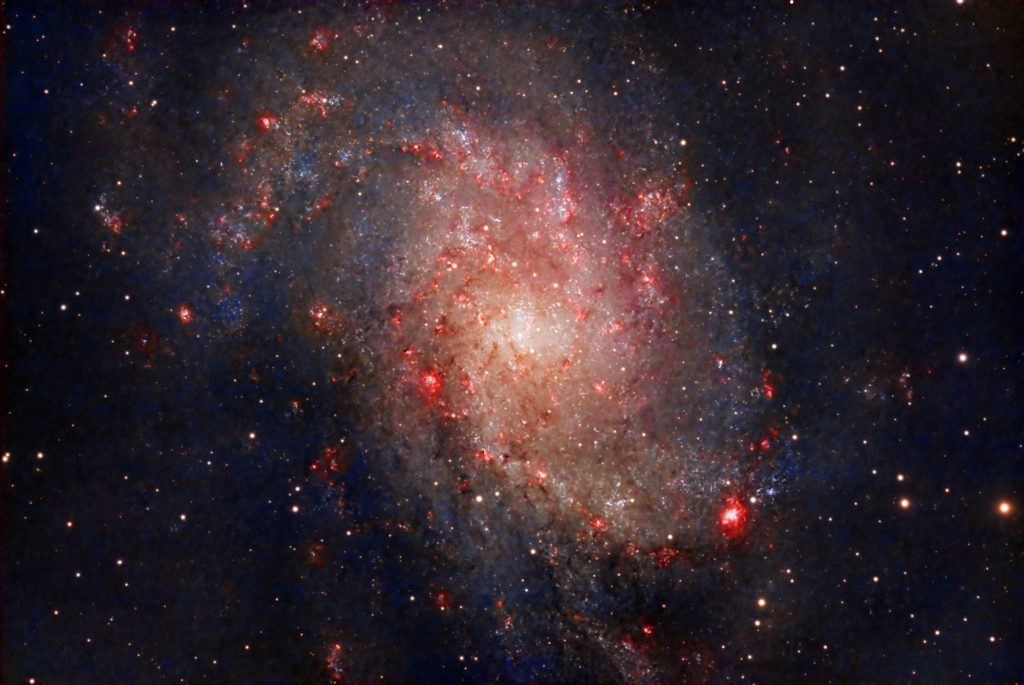
This image reveals M33 in a particularly fascinating way. Rather than being dominated by prominent dark dust lanes, the galaxy is alive with hundreds of glowing red emission nebulae scattered throughout its spiral structure.
These crimson islands of light are not merely beautiful details. They are signposts of active star formation, revealing where new generations of stars are being born across this neighbouring galaxy.
A Galaxy Full of Stellar Nurseries
The Triangulum Galaxy is a barred spiral galaxy, although its structure is less pronounced than that of some other spiral galaxies.
Its sweeping arms contain enormous clouds of hydrogen gas and dust. Within these clouds, gravity brings material together to form new stars.
As massive young stars ignite, their intense ultraviolet radiation energises the surrounding hydrogen gas. The gas responds by glowing strongly in the red wavelengths characteristic of ionised hydrogen.
This creates the remarkable collection of red nebulae scattered across M33.
Among them is NGC 604, one of the largest known star-forming regions in the Local Group. It is an enormous stellar nursery containing hundreds of young, hot stars and spanning roughly 1,500 light-years—many times larger than the region of star formation surrounding the Orion Nebula.
In a sense, the red spots across M33 are cosmic birth announcements.
Each one marks a place where the galaxy is actively creating stars.
A Galaxy That Looks Surprisingly Different
Many galaxy photographs are defined by dramatic dust lanes winding through their spiral arms.
M33 tells a different story.
Its relatively delicate spiral structure and abundance of luminous emission regions give this galaxy a distinctive appearance. Rather than concentrating attention on dark dust, this image draws the eye towards the bright red nebulae distributed throughout its arms.
These regions create a wonderful contrast with the cooler blue-white light of the galaxy’s stellar population.
The result is a galaxy that appears almost sprinkled with jewels—each glowing region representing an enormous cloud of gas illuminated by stars that have only recently emerged from their cosmic birthplace.
A Neighbour in the Local Group
The Triangulum Galaxy is part of the Local Group, the collection of galaxies gravitationally bound together that includes the Milky Way and Andromeda.
At approximately 2.7 million light-years away, M33 is actually one of our relatively close galactic neighbours.
There is also a fascinating connection between these galaxies.
M33 is gravitationally interacting with both the Milky Way and Andromeda, and astronomers believe its future will be influenced by the evolving relationship between the major galaxies of the Local Group.
The Triangulum Galaxy may therefore not always look as it does today.
On the immense timescale of cosmic evolution, galaxies are not isolated islands. They interact, exchange material and influence one another through gravity.
A Journey Through 2.7 Million Years
The light captured in this photograph began its journey approximately 2.7 million years ago.
When those photons left the Triangulum Galaxy, early human ancestors were living on Earth.
They travelled through intergalactic space for millions of years before reaching our planet and being collected by a telescope.
That means every star and glowing nebula in this image is a view of M33 as it existed millions of years in the past.
We are not seeing our neighbour as it is today—we are seeing a chapter from its ancient history.
From Photons to Photograph
Capturing the Triangulum Galaxy requires more than simply recording its bright central region.
The challenge is to preserve the delicate spiral structure while revealing the faint emission nebulae scattered throughout its arms.
Long-exposure imaging accumulates the faint light from the galaxy over extended periods, allowing subtle structures to emerge from the darkness. Additional attention is required to maintain detail across the wide range of brightness between the galaxy’s core, its spiral arms and the much fainter outer regions.
Careful calibration, integration and processing then bring together the enormous collection of captured photons.
Particular emphasis in this image was placed on the red emission regions, allowing the extraordinary concentration of stellar nurseries across M33 to become a defining feature of the composition.
The Astrophotographer’s Perspective
There is something fascinating about photographing a galaxy that is both familiar and surprisingly different.
The Triangulum does not immediately overwhelm the viewer with dramatic dust lanes or a brilliant central bulge.
Instead, it rewards closer inspection.
One by one, the red nebulae begin to reveal themselves, scattered across the spiral arms like distant beacons.
Each is a reminder that somewhere inside this enormous galaxy, stars are being born.
For me, these regions are what give M33 its personality.
The galaxy is not simply a spiral of stars. It is a galaxy alive with stellar birth.
The Artwork
Triangulum Galaxy — A Galaxy Alive With Star Birth offers a different perspective on one of our closest galactic neighbours.
Its graceful spiral structure and remarkable collection of red emission nebulae create a sophisticated composition that rewards both distance and close examination.
At first, the viewer sees an elegant spiral galaxy. Look closer, and hundreds of luminous details begin to emerge—each one potentially marking a stellar nursery millions of light-years away.
Presented as a premium fine-art print, the artwork brings the scale and beauty of a neighbouring galaxy into an interior environment while offering an extraordinary scientific story for those who take the time to explore it.
A galaxy 2.7 million light-years away.
A spiral alive with newborn stars.
Countless red beacons announcing that the universe is still creating.
Related products
-
 Price range: $25.00 through $399.00 This product has multiple variants. The options may be chosen on the product page
 -
 Price range: $25.00 through $399.00 This product has multiple variants. The options may be chosen on the product page