The Moon — A World in Living Colour
Click here to learn more.

Description
Description
The Wonder
Few celestial objects are as familiar—or as deeply connected to humanity—as the Moon.
It has guided travellers, inspired poets, shaped calendars and illuminated countless nights throughout human history. Yet despite its familiarity, the Moon still has secrets that are easy to miss.
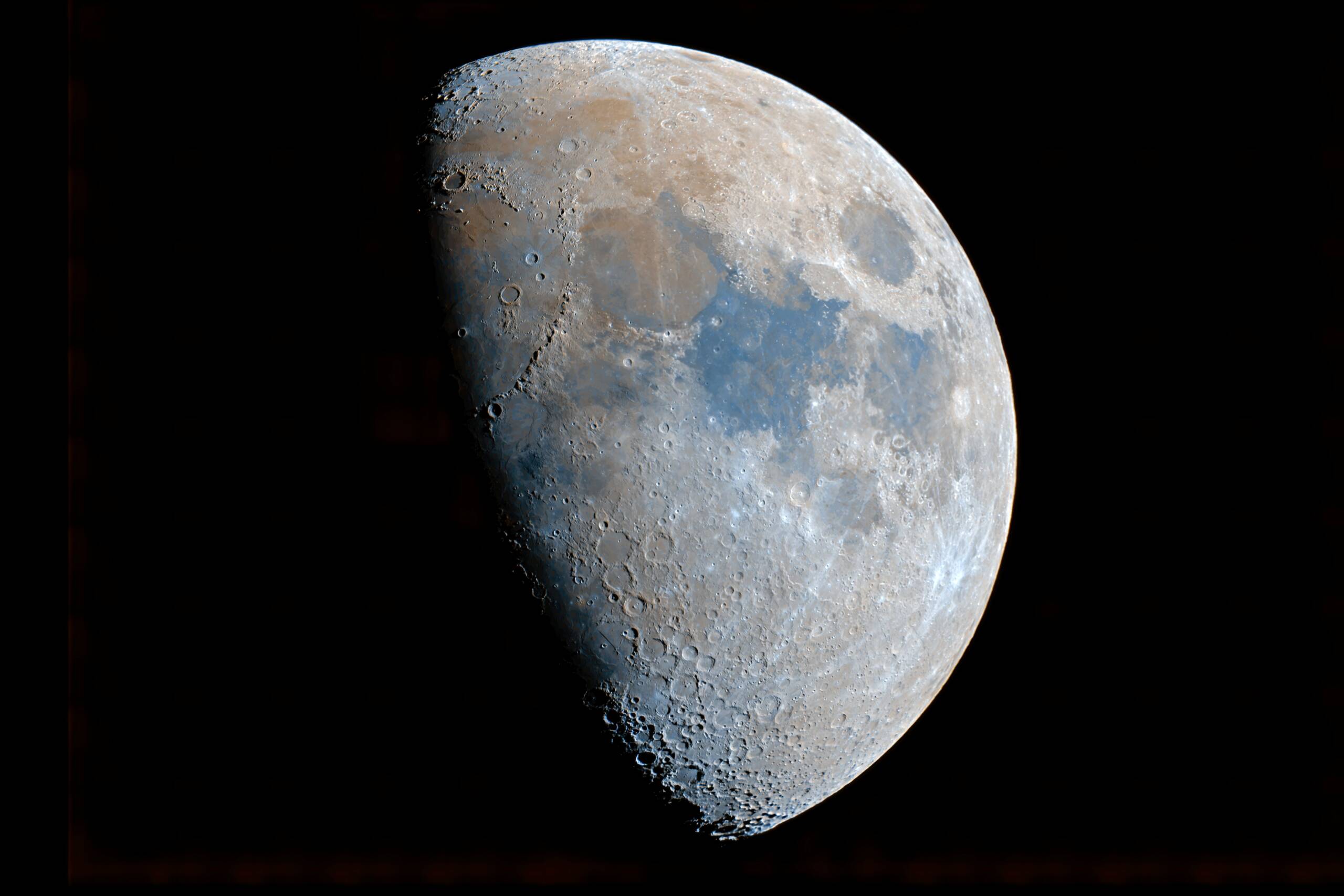
This image captures the Moon at approximately 66% illumination, when the changing angle of sunlight creates a striking balance between brilliant illuminated terrain and the deep shadows of the lunar landscape.
But this is not the Moon as we usually see it.
Look closely and a subtle palette of blue, orange, gold and earthy tones begins to emerge across its surface. These colours are real. They reveal differences in the mineral composition of the lunar soil—subtle variations that are largely invisible to the naked eye.
A Moon Hiding in Plain Sight
The Moon may appear monochromatic when viewed through a telescope, but its surface contains an extraordinary variety of minerals.
The subtle blue tones are associated with areas of basaltic rock containing relatively high concentrations of titanium. Warmer orange and golden regions indicate different mineral compositions and geological histories.
The colours are incredibly subtle, which is precisely what makes revealing them so fascinating.
Rather than creating an artificial fantasy palette, this artwork carefully enhances naturally occurring colour differences within the lunar surface. What emerges is a Moon that feels surprisingly unfamiliar despite being one of the most photographed objects in the sky.
The colours were always there. We simply had to learn how to see them.
The Landscape of Another World
Across the lunar surface lie vast impact craters, mountain ranges, ancient lava plains and countless smaller scars created by billions of years of collisions with asteroids and other bodies.
Unlike Earth, the Moon has no substantial atmosphere, liquid water or active weather system to erase these marks.
As a result, its surface preserves an extraordinary geological record.
Some of the craters visible in this image were formed billions of years ago. Their outlines have remained remarkably well preserved, providing astronomers with a window into the violent early history of the Solar System.
The familiar Moon above us is therefore also an ancient geological archive.
Why 66% Illumination Matters
The changing phase of the Moon is more than a beautiful visual effect.
At approximately 66% illumination, sunlight strikes the lunar surface at an angle that produces long shadows around craters, mountains and ridges. These shadows dramatically emphasise the three-dimensional nature of the terrain.
Features near the boundary between lunar day and night—the terminator—can appear especially spectacular because low-angle sunlight reveals subtle variations in elevation.
This is why the Moon can look completely different from one night to the next.
The landscape hasn’t changed. The light has.
From Lunar Light to Photograph
Photographing the Moon may appear deceptively simple. It is bright, close and visible to the naked eye.
In reality, capturing a detailed lunar image requires careful control of focus, atmospheric turbulence, exposure and image scale.
The Moon is also moving continuously across the sky, while Earth’s atmosphere is constantly shifting and distorting the incoming light. Even on a clear night, moments of poor atmospheric stability can soften the finest lunar detail.
The capture therefore requires careful timing and a large number of individual frames. High-resolution lunar imaging techniques allow the sharpest moments to be selected and combined, producing a final image with considerably more detail than a single exposure could provide.
The colour information then requires an additional layer of precision. Subtle mineral signatures are enhanced carefully so that the geological differences become visible while retaining the natural character of the lunar surface.
Revealing the Colours
One of the most rewarding aspects of this image was discovering how much colour is hidden within a world that appears grey to the naked eye.
Through careful capture and processing, subtle variations in lunar soil can be separated from the overwhelming brightness of reflected sunlight.
The result is a geological portrait rather than simply a photograph of a familiar celestial object.
The Moon becomes a mosaic of different materials, ages and geological events—a world whose surface tells a story written over billions of years.
The Astrophotographer’s Perspective
The Moon is often the first celestial object people learn to recognise.
Perhaps that is why it is so easy to take for granted.
For me, this image was an opportunity to look at something incredibly familiar from a different perspective. Instead of simply recording the Moon’s shape and craters, I wanted to reveal something that most people rarely notice—the subtle colours written into its surface.
There is something particularly satisfying about discovering hidden detail in an object that humanity has been observing for thousands of years.
The Moon reminds us that sometimes we don’t need to look farther into space to discover something extraordinary.
Sometimes we simply need to look closer.
The Artwork
The Moon — A World in Living Colour transforms one of humanity’s most familiar celestial companions into a striking contemporary astronomical artwork.
Its combination of extraordinary detail, subtle natural colour and dramatic lunar shadows makes it equally compelling as a scientific image and as a sophisticated decorative piece.
Displayed at large scale, the artwork invites viewers to move closer and explore the craters, mountains and subtle geological colours across the lunar surface.
For collectors and interior designers, it offers a timeless subject with a surprisingly modern interpretation.
The Moon has watched over Earth for billions of years.
We have looked up at it for as long as we have been human.
Now look again.
Our familiar Moon.
A world of ancient mountains, oceans of frozen lava and colours hidden in plain sight.
Captured in a moment of lunar light.
Need Help Choosing? Let’s Find the Right Fit.
Send us a message with your specs or questions, and we'll guide you through the options.Related products
-
 Price range: $25.00 through $399.00 This product has multiple variants. The options may be chosen on the product page
 -
 Price range: $25.00 through $399.00 This product has multiple variants. The options may be chosen on the product page