A brilliant nova blazed into view in late September 2016: V407 Lup (Nova Lupi 2016). Peaking at magnitude 5.6—barely visible to the naked eye—it then faded rapidly as one of the fastest novae ever recorded en.wikipedia.orgde.wikipedia.org.
📍 J2000 Coordinates:
• RA 15h 29m 01.82s
• Dec –44° 49′ 40.9″ arxiv.orgde.wikipedia.org
🔭 How to Spot It from Australia (Brisbane lat ~27° S):
• Best seen April–June in the southern sky after dusk
• Find the constellation Lupus, nestled between Scorpius and Centaurus
• Locate Epsilon Lupi (mag ~3.5), then sweep ~1–2° east
• The nova lies in that triangular field at the coordinates above
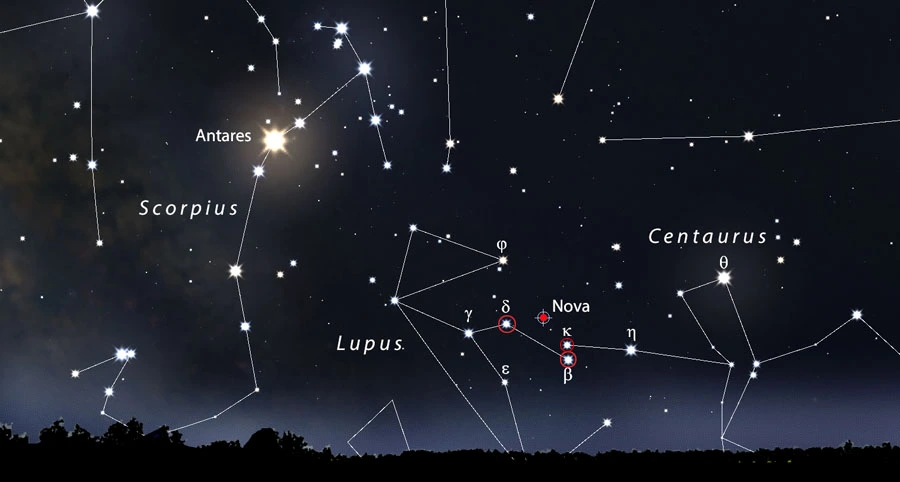
Although it has faded since 2016, the coordinates remain fixed, so your star‑hop still points to the right spot for any lingering glow or future outburst.
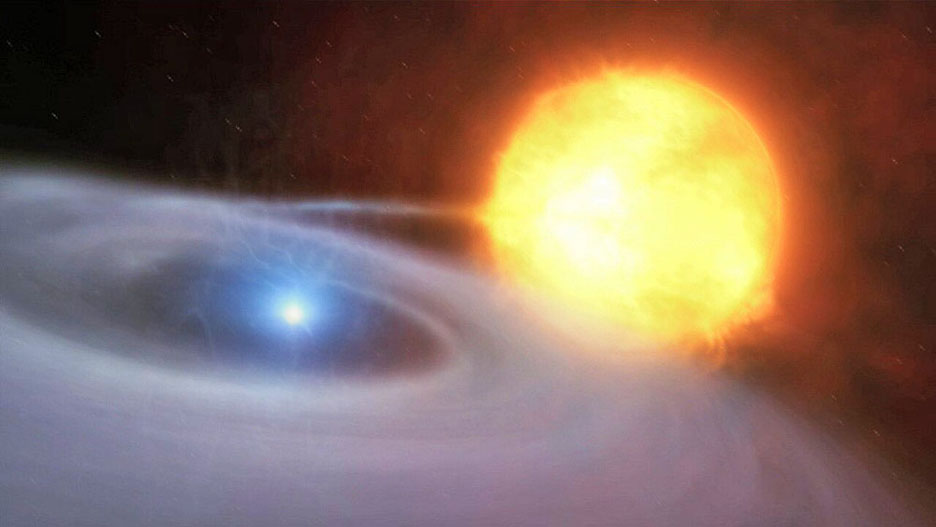
A nova always involves two closely-orbiting stars — a white dwarf and a companion star. In this artist’s view, the white dwarf (at left) robs gas from its companion (at right). The material forms an accretion disk around the dwarf before spiralling down to the surface, where it’s heated and compressed until it ignites in a thermonuclear blast. The explosion causes the system to brighten by many millions of times, as much as 15 magnitudes!
ESO / M. Kornmesser

Visit https://Astroman.au